
Publication Process

THE JOURNAL'S PUBLICATION PROCESS
I Introduction
The journal Anyanyelv-pedagógia [First Language Pedagogy] was founded in 2008 by the Magyar Nyelvtudományi Társaság [Society of Hungarian Linguistics] with the professional support of the Gyula Szemere Research Group in First Language Pedagogy for researchers and educators in applied linguistics and first language pedagogy, as well as for teachers and early childhood educators working in Hungarian. The journal Anyanyelv-pedagógia [First Language Pedagogy] is registered in the Hungarian Scientific Publications Database (MTMT) as a scientific, peer-reviewed journal. It publishes only original contributions and peer-reviewed articles. The journal has been rated "A" by both the Pedagogical Scientific Committee and the Linguistics Committee of the Hungarian Academy of Sciences. Since the journal's launch in 2008, the journal Anyanyelv-pedagógia [First Language Pedagogy] is a libre open access journal.
From Issue 2024/3 onwards the journal is published in the Eötvös Lorand University Open Journal System (ELTE OJS).
Submit manuscripts via the journal’s website, in compliance with the journal’s Privacy Policy, Publication Ethics, Copyright, and Publication Statements, and these Author Guidelines. Publication process: submission of the manuscript, pre‑review, peer review in a double-blind process, manuscript revision, internal review, decision on acceptance or rejection, editing, technical editing, publication, and archiving.
The preparation of the journal’s publication is carried out by the members of the editorial team: the editor‑in‑chief, the deputy editor‑in‑chief, the journal manager, the section editors, the copy editor, the technical editors, the translator, and the language reviewer. Their work is supported by an international advisory board. The members of the editorial team are introduced on the Editorial Team page.
Since January 2025, all editorial and peer‑review processes and related communication have been managed within ELTE OJS. Between 2008 and 2024, editing and double‑blind peer review were conducted via email. In 2025, the editorial team gradually adopted the new OJS‑based workflow. Building on the first years’ experience, the new author, editor, and reviewer guidelines aligned with the OJS system were completed in 2026.
The editorial team carries out its work in accordance with the principles outlined in the journal’s privacy, Open Access, and ethics statements available on the website. The journal is fully committed to upholding, representing, and promoting the highest ethical standards in all aspects of its operations. All individuals involved in the journal’s publication processes—including authors, editors, reviewers, and any additional contributors—are strictly required to adhere to the principles set out in the journal’s official statements. All related activities must be carried out in full accordance with the Core Practices of the Committee on Publication Ethics (COPE) and the Recommendations for Promoting Integrity in Scientific Journal Publications issued by the Council of Science Editors.
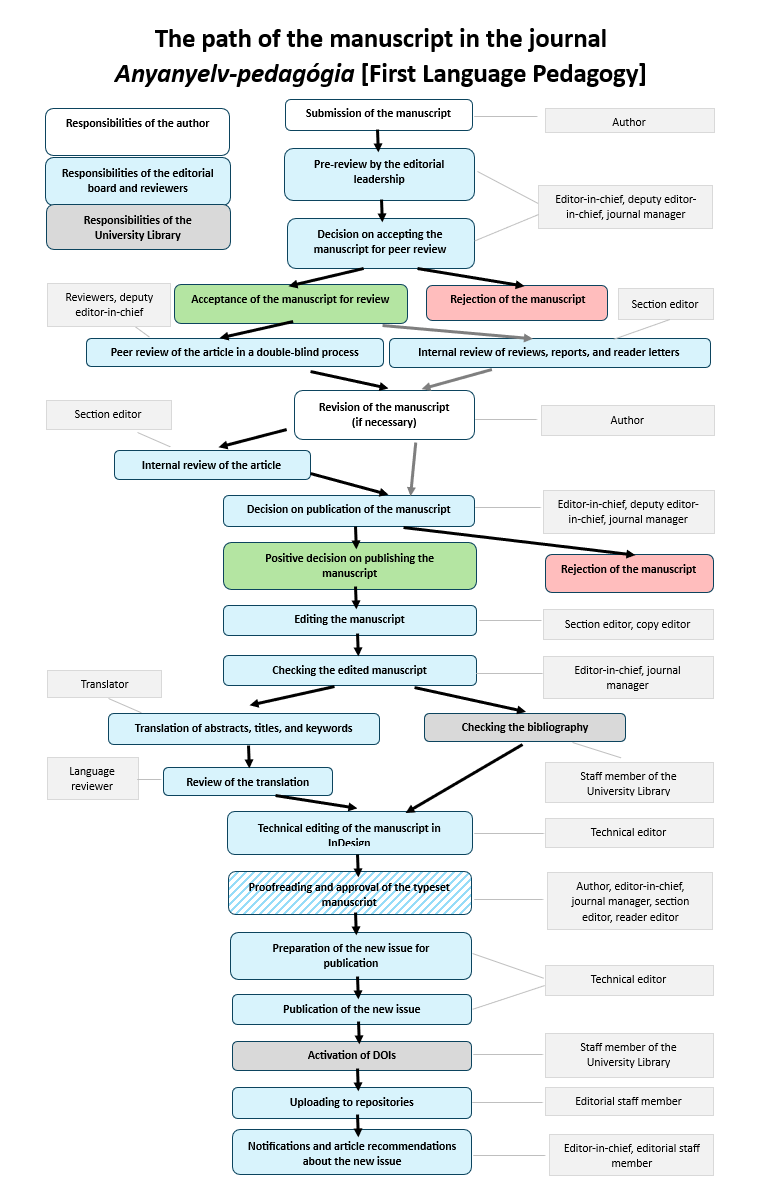
II The Publication Process in ELTE OJS
Phase 1 of the publication process (applies to every submitted manuscript):
- The author submits the manuscript via the journal’s website in ELTE OJS.
- The journal’s leadership (editor‑in‑chief, deputy editor‑in‑chief, journal manager) conducts pre‑review screening: they examine the topic, genre, and overall quality of the manuscript to determine whether it fits the journal’s professional profile; they verify compliance with the Author Guidelines; the deputy editor‑in‑chief checks originality using the Turnitin plagiarism‑detection software and conducts a preliminary literature check. Based on the pre‑review outcome, the journal’s leadership decides whether to send the manuscript for peer review or decline it. If the decision is to decline, the editor‑in‑chief notifies the author in OJS. (For the grounds of rejection, see the Author Guidelines.)
Phase 2 of the publication process for submissions to the Research Articles and From the Field sections
- If the pre‑review outcome is positive, the deputy editor‑in‑chief initiates a double‑blind peer review in OJS using the anonymized version of the study.
- The deputy editor‑in‑chief sends the review reports to the author in OJS. If both reviewers recommend publication, the deputy editor‑in‑chief invites the author to revise the manuscript in line with the reviews and to upload a response to the reviewers in OJS. If both reviews do not recommend publication, the procedure continues in accordance with the journal’s peer‑review policy.
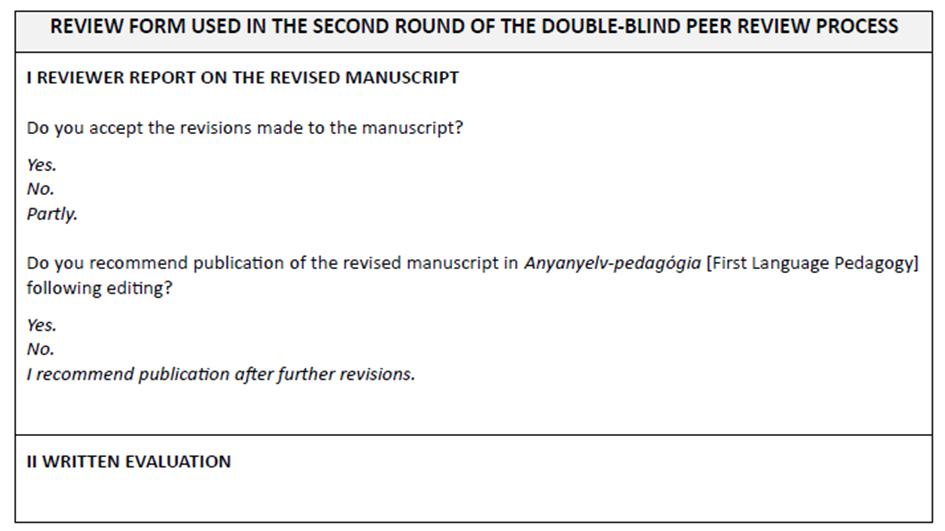
- If the anonymous reviewer requests major revisions to the manuscript, the revised manuscript submitted by the author will be sent back to the anonymous reviewer for a second round of peer review, together with the author's summary of the revisions made.
- If the reviews warrant rejection, the editor‑in‑chief informs the author of the decision.
- With two positive reviews, the author revises the manuscript based on the reviewers’ comments and, by the specified deadline, uploads the revised manuscript to OJS and—from 2026 onwards—also uploads the author response to reviewers.
- If the review outcome is positive, the deputy editor‑in‑chief reviews the revised manuscript and the author response, then forwards the revised manuscript in OJS to the head of the Research Articles or From the Field section.
- The section editor checks in detail whether revisions adequately address the reviews; verifies the structure, content, references and bibliography; and verifies the author data provided in the manuscript. Where necessary, the section editor corresponds with the author. If the section editor’s internal review has a positive outcome, they assign a copy editor in OJS to the manuscript under their care.
- The journal’s leadership decides to accept the manuscript. The editor‑in‑chief informs the author that the manuscript has been accepted.
- If the Section Editor identifies an issue during checking that could warrant rejection (e.g., non‑existent sources cited in the manuscript), they notify the editor‑in‑chief.
- The journal’s leadership investigates, consults the author if necessary, and decides whether to reject or accept the manuscript.
- The editor‑in‑chief notifies the author of acceptance or rejection.
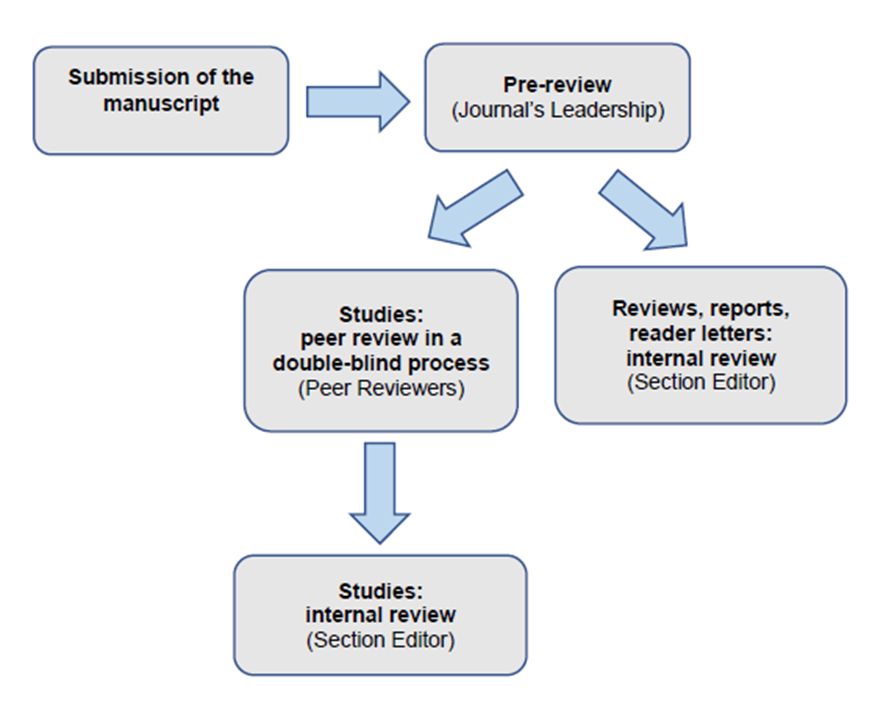
Phase 2 of the publication process for submissions to the Reviews, Viewpoints, and Miscellanea sections, and for reader letters to the Letters to the Editor section
- If the pre‑review outcome is positive, the deputy editor‑in‑chief forwards reports, reviews, and reader letters for internal review to the heads of the Reviews, Viewpoints, Miscellanea, and Letters to the Editor sections for thorough assessment.
- The section editor reviews the manuscript, checking in detail the manuscript’s structure, content, references and bibliography, and the author data provided in the manuscript. Where necessary, the section editor corresponds with the author. If the section editor’s internal review has a positive outcome, they assign a copy editor in OJS to the manuscript under their care.
- The journal’s leadership decides to accept the manuscript. The editor‑in‑chief informs the author that the manuscript has been accepted.
- If the section editor identifies an issue during review that could warrant rejection (e.g., non‑existent sources cited in the manuscript), they notify the editor‑in‑chief.
- The journal’s leadership investigates, consults the author if necessary, and decides whether to reject or accept the manuscript.
- The editor‑in‑chief notifies the author of acceptance or rejection.
Phase 3 of the publication process (applies to every submitted manuscript)
- The copy editor improves language, spelling, and typography.
- The journal manager prepares the manuscript for publication; inserts dates of submission, acceptance, and publication and the article’s DOI; and verifies DOIs in the references.
- The editor‑in‑chief reads the edited manuscripts and, where necessary, makes corrections, then uploads the manuscripts for layout (without proof marks and comments) to the technical editor in OJS for InDesign formatting.
- Based on the edited manuscripts, the editor‑in‑chief sends abstracts, titles, and keywords for English translation or for the verification of author‑supplied translations to the translator.
- The translator prepares the English translations for the forthcoming issue.
- The language reviewer (proofreader) checks the translator’s work.
- The editor‑in‑chief incorporates the approved translations into the manuscripts and forwards them to the technical editor.
- The technical editor lays out the new issue in InDesign.
- The editor‑in‑chief sends the edited, laid‑out version of each contribution to the respective author for review and approval prior to publication.
- The editor‑in‑chief, section editors, copy editor, and journal manager all review the InDesign version of the new issue.
- In parallel with layout, a staff member of the ELTE University Library and Archives checks the bibliographies and DOIs of the articles prior to publication.
- The technical editor revises the articles in the new issue based on received comments and sends the updated version to the editor‑in‑chief for approval.
- The technical editor uploads the editor‑in‑chief‑approved version of the new issue in OJS to the technical editor responsible for publication.
- The technical editor responsible for publication prepares the issue for release in OJS, adds article and author metadata in Hungarian and English to the PDFs, and publishes the issue at the journal’s fixed publication time.
- The technical editor notifies the ELTE University Library and Archives staff member of the publication, who then activates the DOIs for the new issue.
- The editor‑in‑chief notifies authors of the issue’s publication.
- A news item about the new issue appears under Notifications in ELTE OJS, as well as on the journal’s Facebook page.
- The journal’s librarian uploads the articles of the new issue to the ELTE EDIT, and MTA REAL reposotories and deposits article metadata in MATARKA, and MTMT.
- Based on the new issue, the journal’s staff prepare readable and listenable Article Recommendations, including thematic recommendations, and publish them on the journal’s website.
III The Review Process
IV Excerpt from the Ethical Statement of the Journal Anyanyelv-pedagógia [First Language Pedagogy] (10 September 2026)
"1 Ethical principles concerning authors […]
Authors must:
- […] submit studies based on their own research, in accordance with the standards and citation rules of acknowledging and referring to other works, refraining from any forms of plagiarism. Plagiarism is considered a serious violation of academic ethics and is not tolerated;
- properly acknowledge all contributors involved in the research;
- submit original manuscripts that have not been previously published in any other (digital or print) publication;
- […] submit manuscripts based solely on original results and avoid reformulation of previously published findings. In case of partial overlap, they must properly reference their prior publications;
- are responsible for the ethical use of AI tools;
- from Issue 2026/3 onwards at the end of the manuscript, the author must provide a separate paragraph stating whether any AI tools were used in the preparation of the article and in the research described therein; if AI tools were used, the author must specify the name and version number of the tool(s) and indicate the purpose for which artificial intelligence was employed;
- treat the work of fellow researchers with fairness and professionalism, avoiding personal comments or offensive language;
- be responsible for the authenticity and accuracy of the data used in their research;
- clearly indicate the funding sources of their research in the format specified by the journal;
- fully comply with the Author Guidelines of the journal Anyanyelv-pedagógia, and prepare and submit the manuscript accordingly […].
2 Ethical principles concerning the editorial team and editorial processes […]
Editors must:
- […] ensure that all manuscripts are evaluated fairly, professionally, and impartially, regardless of the authors’ ethnicity, religion, nationality, gender, age, or institutional affiliation;
- clearly define and publish the criteria of evaluation and procedures used by the journal;
- be responsible for the quality of the review process and ensure that submitted manuscripts are reviewed by qualified reviewers through a double-blind peer-review process;
- be solely responsible for the acceptance or rejection of manuscripts;
- ensure that the procedures used by the journal, particularly the review process, are free from conflicts of interest;
- guarantee the anonymity of authors and reviewers;
- ensure authors’ and reviewers’ anonymity even when a member of the editorial team who has access to the journal’s website in ELTE’s OJS uploads a manuscript for review; in such cases, to maintain double-blind peer review, the editor-in-chief or deputy editor-in-chief sends the anonymous manuscript to the reviewers via email; the reviewers then return their anonymous review comments via email to the editor-in-chief or deputy editor-in-chief, who uploads the anonymous reviews to the OJS system, where the author can view them […].
3 Ethical principles concerning the peer review process
The journal publishes only peer-reviewed articles. The journal’s ethical principles, as well as the Core Practices of the Committee on Publication Ethics (COPE) and the recommendations of the Council of Science Editors, apply to the peer review process and to all participants involved in it.
All submitted manuscripts undergo a pre-review screening prior to peer review, carried out by the editorial leadership (editor-in-chief, deputy editor-in-chief, journal manager).
The main criteria of the pre-review screening are:
- alignment of the manuscript topic with the journal’s scope;
- suitability of the manuscript genre to the journal’s profile and sections;
- appropriateness of the manuscript’s style to the journal’s profile and to the genre of submission (article, report, review, or reader letter);
- compliance with the journal’s author guidelines;
- plagiarism check;
- preliminary verification of the authenticity of references.
To ensure academic quality, studies submitted to the journal undergo a double-blind peer review process. Each manuscript is evaluated by two expert reviewers. All communication between authors and reviewers is mediated by the editors. The identity of reviewers and review reports are not disclosed. Between 2008 and 2024, the peer review process and double-blind review were conducted via email. From January 2025, the peer review process has been managed through the ELTE OJS system.
Conflict of Interest
- If a member of the editorial team is the author of the manuscript, they may not participate in the review, decision-making, or editorial processes related to the manuscript.
- The anonymous reviewers of the manuscript and the section editor acting as editorial reviewer must not have any family, hierarchical workplace, or business relationship with the author of the article.
- If a submitted manuscript is authored by a member of the editorial team who has access to the journal’s OJS interface, the editor-in-chief or deputy editor-in-chief sends the anonymous manuscript to the reviewers via email; the reviewers then return their anonymous review comments via email to the editor-in-chief or deputy editor-in-chief, who uploads the anonymous reviews to the OJS system, where the author can view them.
- If, due to the specialized nature of the topic, an editorial team member serves as a reviewer in the double-blind process, they must not have access to the journal’s OJS interface until the article is published, in order to preserve double anonymity.
- Manuscripts of reports, reviews, and reader letters are evaluated internally by a member of the editorial team (section editor). If the author of such a submission is a member of the editorial team, they may not act as the internal reviewer; instead, another editorial team member conducts the review following the pre-review screening.
- The author of a book review must not have any family, hierarchical workplace, or business relationship with the editors or authors of the work under review.
- Advertisements and commercial promotions are not permitted either in the journal’s articles or on its website.
If the author of the article or the work presented in the article is a member of the editorial board of the journal, from Issue 2026/3 onwards the article contains the Editorial Conflict of Interest Statement:
(Name), the author of the article / the work presented in the article, is a member of the editorial board of the journal Anyanyelv-pedagógia [First Language Pedagogy] as (position title). However, they had no involvement in the review of the manuscript, the peer-review process, the editorial process, or the related decision-making. The manuscript was reviewed and edited by independent reviewers and editors. Accordingly, no conflict of interest exists.
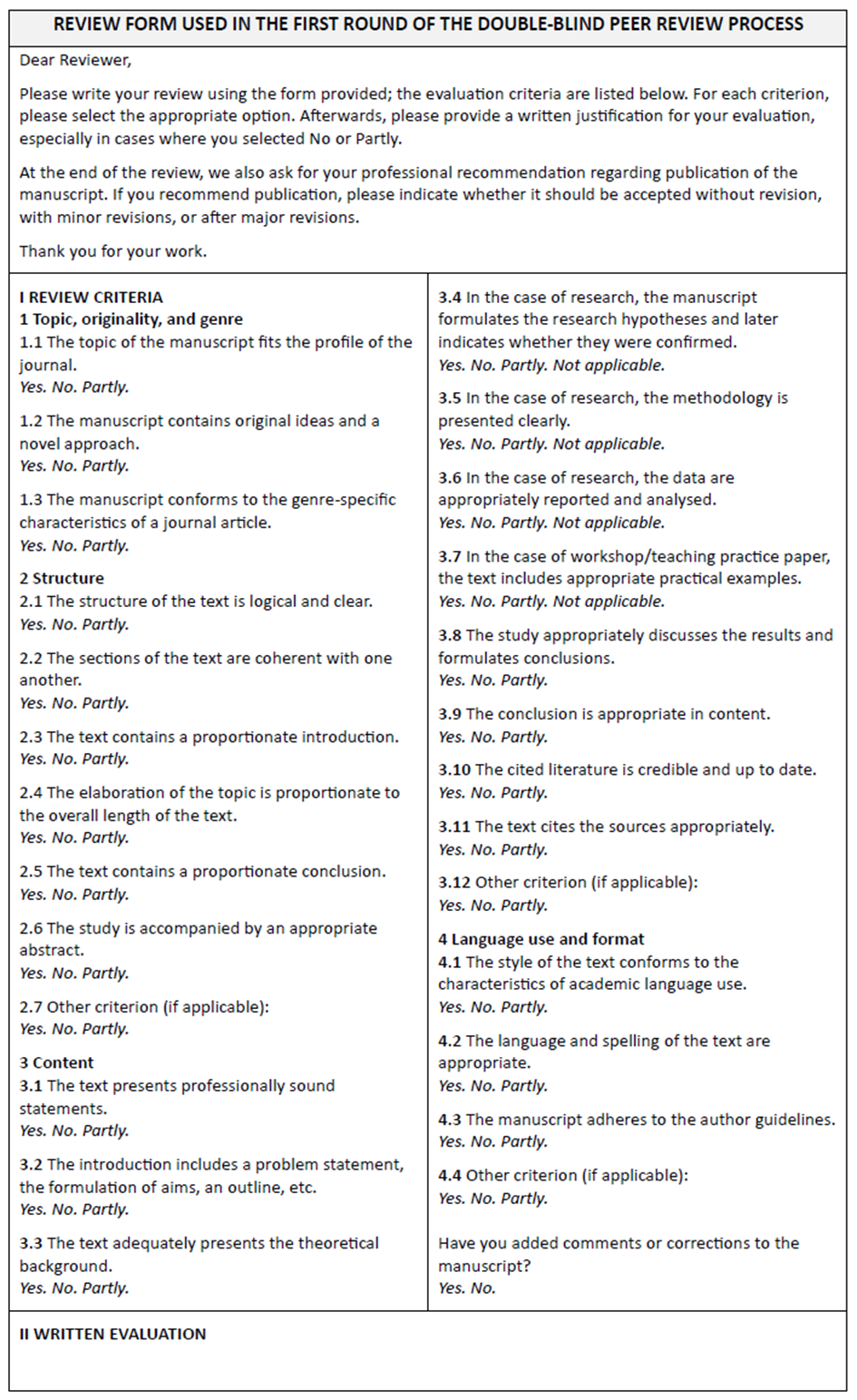
The main criteria of double-blind and internal review are:
- relevance of the topic, originality, and genre of the manuscript;
- compliance with the journal’s author guidelines;
- structure of the text;
- reliability and validity of the content;
- appropriate development of the introduction, the main exposition, the argumentation, and the conclusion;
- completeness and accuracy of references;
- reliability, relevance, and currency of the literature used;
- consistency between references and citations;
- style, language, spelling, and typography.
Review Forms […]
Reviewers must:
- only accept review requests if they have the required skills and knowledge to review the manuscript properly and objectively;
- notify the editor of any violation of norms or conflicts of interest that might affect the objective and anonymous review process;
- decline the review if they are not eligible to evaluate the manuscript or if any conflict of interest exists;
- by accepting the invitation, agree to comply with the journal’s ethical and review standards and procedures;
- must not use artificial intelligence to prepare their review and must not upload the manuscript text into AI tools;
- may use AI tools solely for preliminary verification of references, but must always perform human verification;
- provide their reviews within the agreed timeframe in a clear and professional manner, adhering to the journal's procedures and justifying each element of their evaluation;
- prepare reviews that contain only professional opinions, avoiding personal comments, offensive remarks, or offensive language;
- pay special attention to any lack of proper referencing in the manuscript;
- inform the editorial leadership if there is any suspicion of violations of academic or ethical standards;
- must not include any information in their review that could reveal their identity;
- handle the manuscript received for review with strict confidentiality.
4 Conditions for acceptance or rejection of manuscripts
Conditions for the acceptance of a manuscript:
- The manuscript is deemed suitable for publication based on the pre-review screening.
- In the double-blind peer review process, both reviewers consider the manuscript suitable for publication.
- The manuscript is also approved for publication based on the section editor’s evaluation.
- Reviews, reports, and reader letters may be published based on the thorough internal review conducted by the section editor.
Reasons for final rejection of a manuscript:
- The topic of the manuscript does not align with the profile of the academic journal.
- The genre of the manuscript does not align with the profile of the academic journal.
- The style of the manuscript does not align with the profile of the academic journal and with the genre of the submission (article, report, review, or reader letter). In this case, the author may resubmit a revised version as a new manuscript, which will undergo a new review process.
- The author has committed a breach of academic ethics:
- prior publication of the manuscript with another publisher or simultaneous submission to another publisher;
- confirmed plagiarism in the manuscript;
- inclusion of non-existent references in the bibliography;
- citing existing sources while presenting data or claims not contained in those sources;
- presenting data or claims attributed to the author’s own research without proper evidence;
- verifiable unethical or inadequately documented use of AI tools.
- Outcome of the double-blind peer review: neither reviewer considers the manuscript suitable for publication; one reviewer rejects the manuscript and the other recommends major revisions.
- Outcome of the internal review of reviews, reports, or reader letters: the manuscript is not suitable for publication.
- The author fails to revise the manuscript by the specified deadline based on reviewers’ comments and editorial suggestions. In this case, the author may resubmit a revised version as a new manuscript, which will undergo a new review process.
- If, after publication, a violation is discovered that would have justified rejection, the editorial board will retract the article.
If the anonymous reviewer requests major revisions to the manuscript, the revised manuscript submitted by the author will be sent back to the anonymous reviewer for a second round of peer review, together with the author's summary of the revisions made.
The editorial board appoints a third reviewer if, in the double-blind review process, one reviewer rejects the manuscript while the other recommends minor revisions or acceptance without changes. If the third reviewer also does not consider the manuscript suitable for publication, the manuscript is rejected definitively.
Reasons for rejection with the possibility of revision:
- The manuscript does not comply with the author guidelines regarding format, typography, and required sections.
- The length of the manuscript significantly deviates from the minimum or maximum limits specified in the author guidelines.
- The references and citations are authentic, but their bibliographic details are inaccurate, or the references and citations are not consistent with each other.
- The author did not submit an Author Statement on the Use of Artificial Intelligence with the manuscript (from 2026/3 onwards).
Ethical principles concerning plagiarism handling:
- If plagiarism is suspected, the editorial board conducts a thorough human review of the manuscript.
- If plagiarism is confirmed, the manuscript is rejected without the possibility of revision. The rejected manuscript may not be resubmitted.
- If plagiarism is confirmed after publication, the editorial board retracts the published article.
Post-publication corrections and retractions:
- The editorial team does not correct typographical or language errors after publication.
- If a serious academic error is confirmed after publication, a committee (editor-in-chief, deputy editor-in-chief, journal manager, section editor) decides whether to retract the article or issue a correction.
- If a breach of academic ethics is confirmed after publication, the editorial board retracts the article.
Grounds for permanent exclusion of an author from publication in the journal:
- If an author’s manuscript is rejected for a second time due to any breach of academic ethics, the author is permanently excluded from publishing in the journal. This decision is final and cannot be appealed.
- The editorial board also permanently excludes the author if one of their articles published in Anyanyelv-pedagógia [First Language Pedagogy] is subsequently retracted for any reason. This decision is final and is not subject to appeal.
5 Ethical use of AI tools […]
- From Issue 2026/3 onwards at the end of the manuscript, the author must provide a separate paragraph stating whether any AI tools were used in the preparation of the article and in the research described therein. If AI tools were used, the author must specify the name an dversion number of the tool(s) and indicate the purpose for which artificial intelligence was employed.
The declaration should contain one of the following mandatory template statements:
I did not use any AI tools in the preparation of this article. (for a single author)
We did not use any AI tools in the preparation of this article. (for multiple authors)
I used AI tools in the preparation of this article for the following purposes: (please specify the tasks precisely, as well as the name and version number of the AI tool(s) used). (for a single author)
We used AI tools in the preparation of this article for the following purposes: (please specify the tasks precisely, as well as the name and version number of the AI tool(s) used). (for multiple authors)
If the article presents a detailed description of the results of one or more research projects, one of the following two additional template statements must also be selected:
I did not use any AI tools in the research described in this article. (single author)
We did not use any AI tools in the research described in this article. (multiple authors)
No AI tools were used in the research described in this article. (neutral form)
I used AI tools in the research described in this article for the following purposes: (please specify the tasks precisely, as well as the name and version number of the AI tool(s) used). (single author)
We used AI tools in the research described in this article for the following purposes: (please specify the tasks precisely, as well as the name and version number of the AI tool(s) used). (multiple authors)
AI tools were used in the research described in this article for the following purposes: please specify the tasks precisely, as well as the name and version number of the AI tool(s) used). (neutral form)
- Authors may use AI tools in the preparation of the manuscript in the following cases:
- preliminary collection of relevant literature with human verification;
- generating suggestions for the manuscript title;
- translating the abstract, title, and keywords with human verification;
- verifying the authenticity of references with human verification;
- generating stylistic suggestions for parts of the manuscript text;
- generating images and figures included in the manuscript, with precise source attribution and clear indication of the AI tool used.
- It is prohibited to present and submit AI-generated content as one’s own intellectual work or original results. The use of AI-generated outputs or content (text, images, audio, data) without proper attribution constitutes a breach of academic ethics. If confirmed by peer review or editorial checks, the editorial board will reject the manuscript definitively. A rejected manuscript may not be resubmitted.
- Members of the editorial team and reviewers may use AI tools as follows:
- The editorial leadership uses the Turnitin plagiarism detection software provided by Eötvös Loránd University to check manuscripts for plagiarism. In cases of suspected plagiarism, a human review is also conducted.
- Editorial team members and reviewers must not upload manuscript texts into AI tools.
- Editorial team members may use AI tools for preliminary verification of references and for translation, but human oversight is required in all cases.
- Reviewers must not use AI tools to prepare their review and must not upload the manuscript text into AI tools.
- Reviewers may use AI tools solely for the preliminary verification of references, but human verification is required in all cases.
- If editorial team members or reviewers use AI tools, they are responsible for their ethical use. […]"
V Publication Dates Displayed with the Article
- Date received: date of manuscript submission via the journal's website.
- Date accepted:
- For issues 2024/4 to 2026/1: date of assignment to the section editor and of the initial editorial decision following peer review;
- From 2026/2 onwards: date of assignment to the copy editor and of the editorial decision following peer review and section editor review.
- Date published: date of publication of the article on the journal's website.