
Archives
-
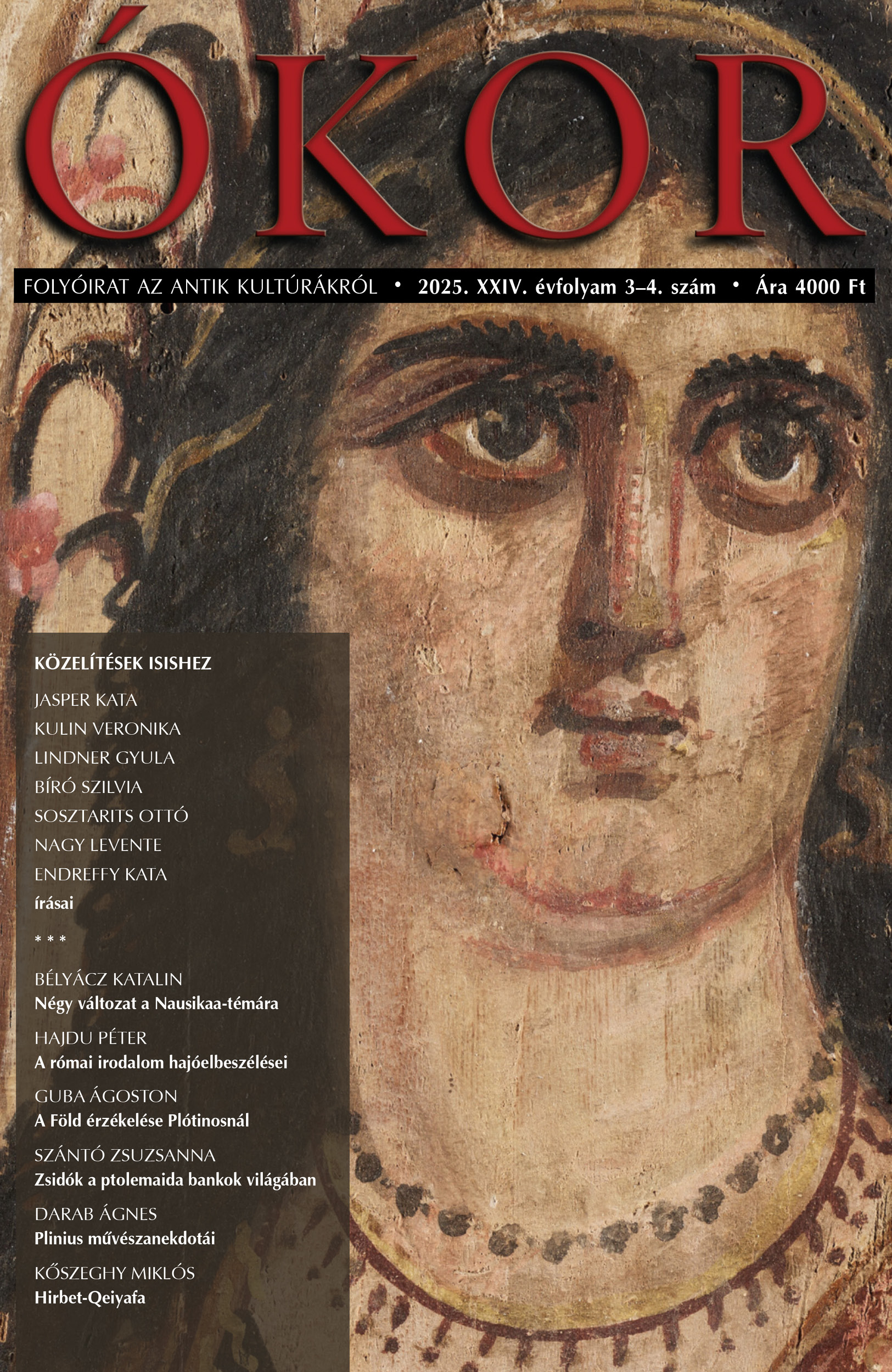
Approaches to Isis
Vol. 24 No. 3–4 (2025)The religious cultures of the ancient Mediterranean developed through continuous interaction with one another. The cult of Isis, Egyptian in origin but embedded in new religious, cultural, and interpretative contexts across the Greek and Roman worlds, provides a particularly complex example of these processes. Its Pannonian remains, above all the sanctuary complex of Isis at Savaria, also demonstrate that the territory of present-day Hungary formed an integral part of these Mediterranean networks. The thematic section of this issue grew out of the conference Approaches to Isis – The Faces of a Mediterranean Goddess, held at the University of Pécs. Its studies examine the figure and cult of Isis from ancient Egyptian conceptions of the afterlife through Greek and Roman religious culture to her presence in Pannonia, bringing together perspectives from Egyptology, classical scholarship, archaeology, and the history of religions. The thematic section is complemented by studies addressing a range of questions in ancient literary, philosophical, artistic, social, and economic history, from the reception of the Nausicaa story and narratives of ships in Roman literature to Plotinus’ theory of perception, Ptolemaic Egypt, Pliny the Elder’s anecdotes about artists, and the archaeological problems surrounding Khirbet Qeiyafa. The Dualis section returns to the issue’s central theme by tracing transformations in the iconography of Isis. With the publication of this issue, we also remember Zsigmond Ritoók, a regular contributor to Ókor since its foundation and one of the journal’s most important intellectual supporters.
-

Erőszak
Vol. 24 No. 2 (2025)The current issue of Ókor examines the various forms and meanings of violence in the ancient world. Approaching the topic from multiple periods and genres, the studies demonstrate that violence becomes visible not only on the battlefield, but is also embedded in everyday social relations, status differences, and the fabric of urban coexistence. Narratives of Roman origin traditions present violence as a foundational pattern of communal self-definition, while accounts of maintaining political order reveal the heightened tensions between elite and populace. In Greek tragedy, the problems of bodily destruction are intertwined with the presence of the divine, whereas in the poetry of Ovid, the experience of trauma and transformation emerges at the boundaries of language and the body. Within the self-reflexive layers of Roman literature, violence becomes a tool of narrative and generic reinterpretation: poetic treatments of civil war both evoke and call into question the rhetoric of historical violence. The aim of this issue is to place these diverse approaches side by side in order to show that violence in ancient cultures constitutes a fundamental, formative, and identity-shaping experience. In addition to the thematic studies, the issue is complemented by contributions in the Textus, Books, and Dualis sections.
-

Vol. 24 No. 1 (2025)
The inaugural issue of 2025, non-thematic in scope, showcases a wide-ranging collection of studies. The opening article explores the sanctity of texts from historical, religious, and philological perspectives. Another contribution analyzes the performative ambiguity of a Sappho fragment, revealing subtle layers of poetic communication. Readers will also find a study of the symposium as the cultural context of Pindar’s and Bacchylides’ victory odes, as well as an examination of early ship representations in the western desert oases. The archaeology section highlights recent research on Tutankhamun’s famous dagger made of meteoritic iron. The Textus section presents three annotated source texts: an ancient Egyptian curse against charioteers, the hexameter poem of the Sinai palimpsest, and the Hungarian translation of the correspondence between Károly Kerényi and Martin Buber. Finally, Dualis closes the issue with a contemporary reflection on balance and movement in ancient art.
-

Myth and Drama
Vol. 23 No. 3–4 (2024)This issue is linked to a workshop conference held in Pécs in November 2023, celebrating the 70th birthday of György Karsai. The papers explore the multifaceted world of ancient literature and theatre: the comic and tragic sides of Homer’s Paris, Pindar’s victory ode that strikingly incorporates mourning, the “discreet charm of everyday life” in Aeschylus’ satyr play, the religious experience of Euripidean heroes, and the theatrical worlds of Aristophanes and Plautus. Other contributions examine the shared language of grammar and medicine in antiquity, the social impact of imperial mime, the Greek gods of Thomas Mann, and contemporary stagings of Antigone. The sections bring further highlights: a threefold look at the Museum of Fine Arts’ Mesopotamia exhibition, a report on the successful Non Scholae Festival, and a review of a landmark monograph on Hungary’s reception of antiquity. The issue closes with a playful Dualis in the form of a crossword puzzle.
-

Vol. 23 No. 2 (2024)
The papers in this issue approach antiquity from historical, religious, musical, art-historical, and literary perspectives. They examine the political role of the Samaritan temple on Mount Gerizim, the economic history of Iron Age Lachish, Cato’s self-representation during the Catilinarian conspiracy, and the background of demolition bans in Roman cities. Further contributions discuss Jacopo Peri’s Baroque pastoral Euridice based on the Orpheus myth, as well as a unique Egyptian cosmetic spoon. The Textus section presents a new Hungarian translation and commentary of Plautus’ Poenulus, while Dualis offers insight into the ancient practice of artist signatures.
-

Green Antiquity
Vol. 23 No. 1 (2024)With its thematic issues, Ókor consistently seeks — within the framework of ancient civilizations — to foreground, revisit, or reframe the questions that most engage both Hungarian and international scholarship, and to offer answers grounded in antiquity. Our special issue “Green Antiquity” presents a rich selection of papers on nature as it appears in myth and literature, on the relationship between human beings and their environment, on the contrast between cultivated landscapes and wilderness, and on the mythical, aesthetic, ethical, and cultural dimensions attached to them. To recall Sándor Radnóti’s far-reaching cultural-historical reflection: “Landscape exists only through human eyes; it comes into being when it is perceived.” Although this radical shift in the perception of landscape is usually dated to the later seventeenth century, its traces can also be discerned in antiquity. In nature and in the animals of the wild we encounter the perpetual Other — the alien, the untamed. Yet such boundaries may blur: a human may become animal again; built environments may yield to the impersonal advance of nature; and humans, in turn, may reshape landscapes — removing mountains or redirecting rivers.
-
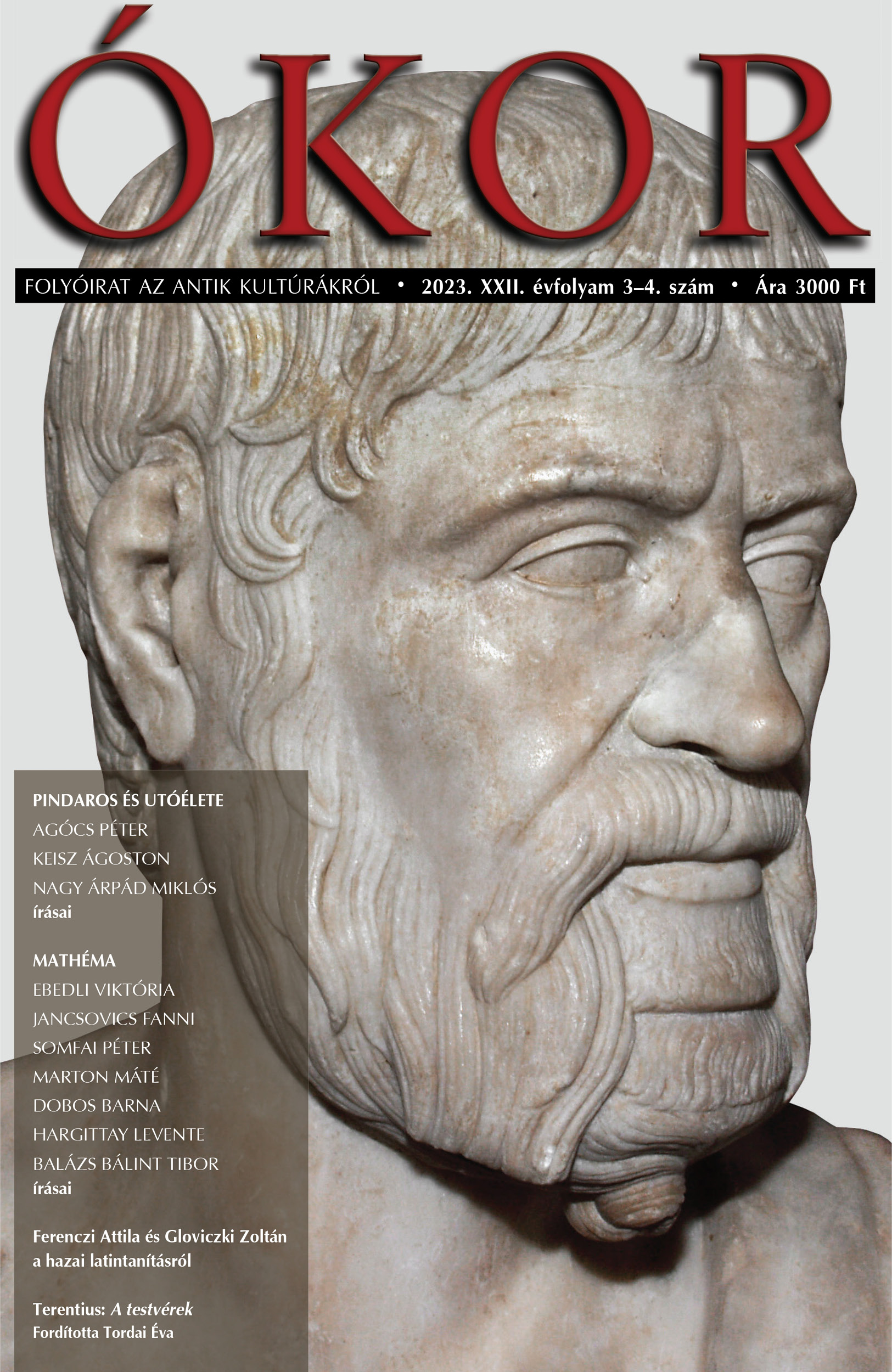
Pindar and His Afterlife
Vol. 22 No. 3–4 (2023)This issue is unusual in that it is not organized around a single central theme; instead, the reader will find in it a smaller thematic section and a larger selection connected to a particular occasion. Under the title Pindar and His Afterlife—edited by Attila Ferenczi and prepared within the framework of the NKFIH grant no. K 124232—readers can find Péter Agócs’s comprehensive study of Pindaric metapoetics, Ágoston Keisz’s paper on a fundamental yet distinctive figure of the Hungarian reception of Pindar, László Tóth of Ungvárnémeti, as well as Miklós Árpád Nagy’s interpretive overview of ancient portraits of Pindar. The latter text also serves as the founding piece of a new section, Dualis, created through the collaboration of Ókor and the Palladion Workshop. From now on, in keeping with its name, it will have a dual presence: according to our plans, it will appear in every issue of the journal while simultaneously announcing itself on the Palladion website. As is already evident in this issue, Dualis forms an organic unity with the images placed on our color covers and calls attention to the beauty and indispensability of ancient art—this time, naturally, with the help of portraits of Pindar. We extend our grateful thanks to Hans Rupprecht Goette (Berlin, Deutsches Archäologisches Institut, Zentrale) for the photographs. The other, more extensive section presents a selection from the proceedings of the 2023 Mathéma conference. This annual conference of young scholars of antiquity—among them undergraduate students, doctoral students and candidates, as well as recent PhD recipients—held each year at the Faculty of Humanities of ELTE, has become an increasingly important forum for Hungarian-language classical scholarship. Its papers, discussions, and the volumes edited from the conference materials and published each year provide an excellent reflection of the most exciting current directions in the study of antiquity.
-
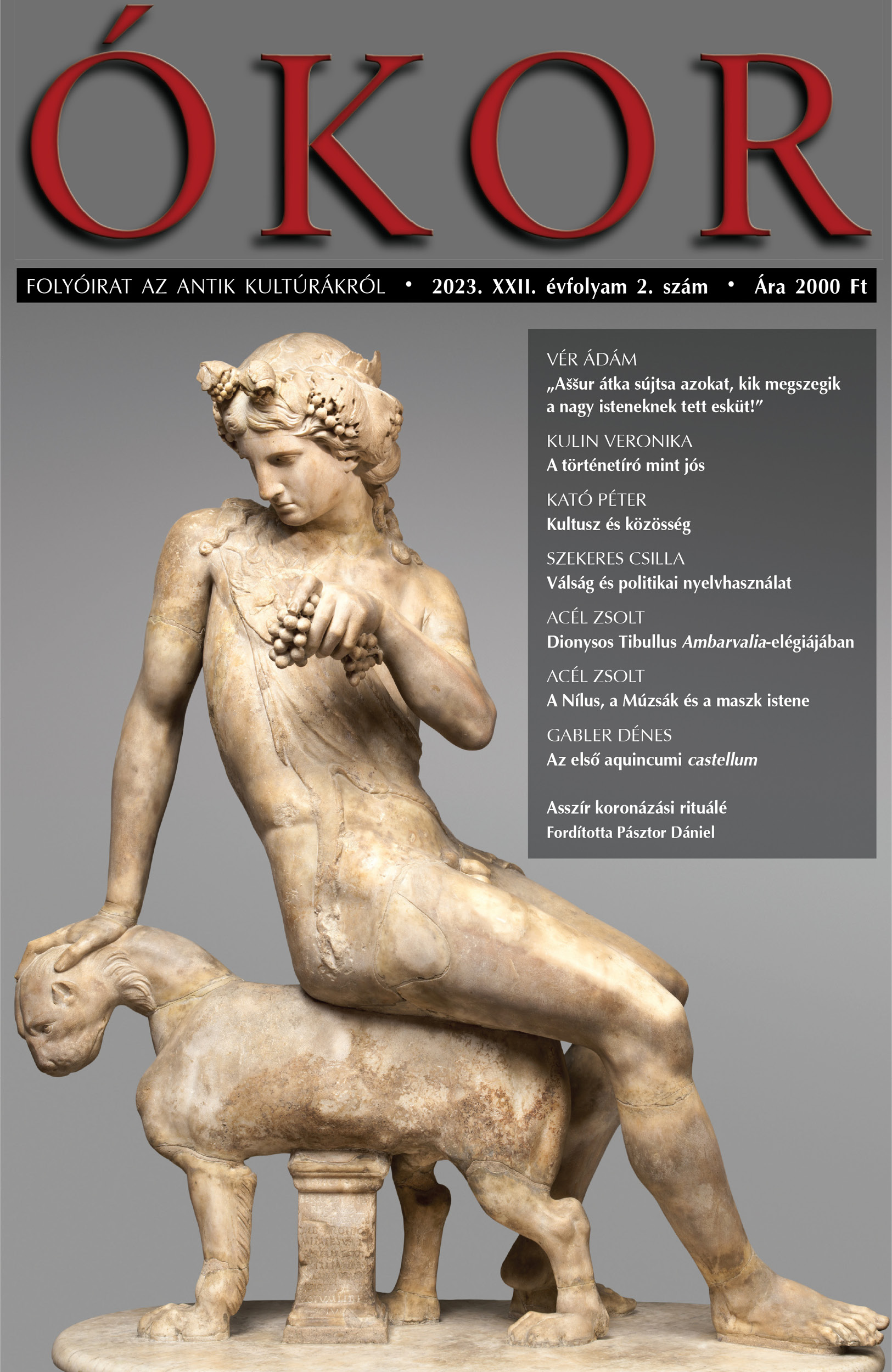
Vol. 22 No. 2 (2023)
The present issue of Ókor offers an excellent illustration of the diversity of Classical Studies, as its contributions examine political, religious, and literary phenomena from the ancient Near East and the Greco-Roman world through a variety of source materials and methodological approaches, including philology, history, epigraphy, and archaeology. The opening article analyzes the political and religious functions of oaths in Assyrian administration, highlighting the sacral dimensions of state authority and legitimacy. Veronika Kulin’s study investigates Herodotus’ historiographical practice, with particular attention to questions of causality and historical explanation. Through an analysis of an honorific decree issued by a cult association on Kos, Péter Kató explores the relationship between communal identity and religious organization. The articles devoted to Roman topics examine both the political discourse of the late Republic and the religious-poetic dimensions of the works of Tibullus and Nonnus. The archaeological section contributes new perspectives on the problem of the early military infrastructure of Aquincum, while the Textus section presents an annotated Hungarian translation of an Assyrian coronation ritual.
-
Állatok Egyiptomban
Vol. 22 No. 1 (2023)Utoljára 2014-ben jelentetett meg az Ókor tematikus számot az állatokról (2014/3). Az akkor közölt tanulmányok különféle ókori civilizációk állattartását és az állatokról alkotott elképzeléseit vizsgálták és ismertették; az összeállítást Liptay Éva egyiptológiai tárgyú írása nyitotta meg. Az idei első szám szintén állatokkal foglalkozik, de ezúttal erre az egy civilizációra összpontosítva: az ókori Egyiptomban tisztelt és az ókori egyiptomi művészetből az európai műveltségbe is átkerült álla-tokkal és keveréklényekkel. A tanulmányok a 2022. szeptember 22-én a Szépművészeti Múzeum Egyiptomi Gyűjteménye által rendezett Ókori egyiptomi állatok régen és ma című konferencián elhangzott előadások szerkesztett változatai.
