
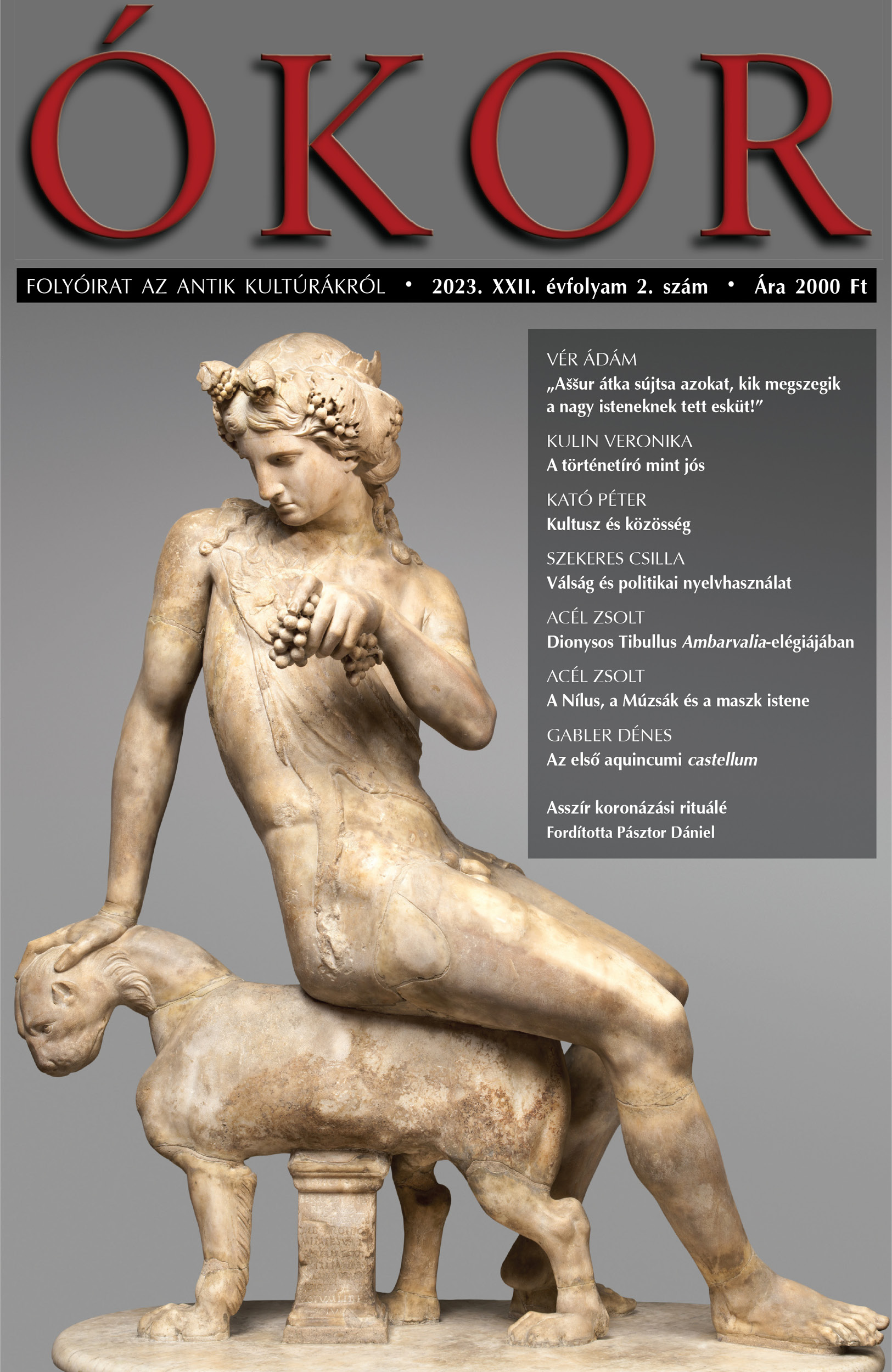
Dionysos in Tibullus’ Ambarvalia Elegy
DOI:
https://doi.org/10.63872/HZMZ7995Keywords:
Tibullus, Dionysus, Ambravalia, elegy, poetic role-playAbstract
This article examines Tibullus 2.1 in light of Dionysus’ presence within the context of the agricultural festival of the Ambarvalia. The study shows that introducing Dionysus—typically not associated with this Mars-related ritual—creates a thematic and poetic tension. Dionysian motifs such as wine, fertility, and ecstasy not only enrich the elegy’s imagery but also complicate Tibullus’ poetic persona. By exploring the intersection of cultic and literary registers, the article argues that Dionysus operates not merely as a thematic element but as a poetic principle—an agent of transgression that reshapes language and identity within the elegiac framework.
References
Acél Zs. 2018. A látható könyvtár. A palatiumi Apollo-könyvtár és a római irodalmi élet. Budapest.
Acél Zs. 2020. "Dionysos, az érkező isten? Előzetes megfontolások az Augustus-kori elégiaköltészet Bacchus-alakjának értelmezéséhez": Ókor 19/2, 3-25.
Barchiesi, A. 2001. Speaking Volumes. Narrative and Intertext in Ovid and Other Latin Poets. London.
Bettini, M. 2014. "Comparazione": M. Bettini - W. M. Short (szerk.): Con i Romani. Un'antropologia della cultura antica. Bologna, 23-44.
Bettini, M. 2019. Dèi e uomini nella Città. Antropologia, religione e cultura nella Roma antica. Róma.
Bettini, M. 2022. Roma, città della parola. Torino.
Bilinski, B. 1986. "Riflessi dell'antropologia culturale nelle poesie di Tibullo": S. Mariotti (szerk.): Atti del Convegno internazionale di studi su Tibullo. Róma, 167-195.
Bouquet, J. 1996. "La nuit, le sommeil et le songe chez les élégiaques latins": Revue dés Études Latines 74, 182-211.
Cairns, F. 1979. Tibullus. A Hellenistic Poet at Rome. Cambridge.
Cairns, F. 1984. "Propertius and the Battle of Actium (4, 6)": T. Woodman - D. West (szerk.): Poetry and Politics in the Age of Augustus. Cambridge, 129-168, 229-236.
Della Corte, F. 1986. "Tibullo tra esterofilia e patriotismo": S. Mariotti (szerk.): Atti del Convegno internazionale di studi su Tibullo. Róma, 1-28.
Dettmer, H. 1983. "The Corpus Tibullianum (1974-1980)": Aufstieg und Niedergang der römischen Welt II. 30.3. Berlin - New York, 1962-1975. https://doi.org/10.1515/9783110847048-016
Fabre-Serris, J. 2001. "Deux réponses de Tibulle à Virgile. Les élégies II, 1 et II, 5": Revue des Études Latines 79, 140-151.
Fischer, J. M. 1983. "The Life and Work of Tibullus": Aufstieg und Niedergang der römischen Welt II. 30.3. Berlin - New York, 1924-1961. https://doi.org/10.1515/9783110847048-015
Foulon, A. 1987. "Les laudes ruris de Tibulle. II, 1, 37-80. Une influence possible de Lucrèce sur Tibulle": Revue des Études Latines 65, 115-131.
Fowler, W. W. 1908. "Lustratio": R. R. Marett (szerk.): Anthropology and the Classics. Oxford, 169-191.
Graf, F. 2009. A mágia a görög-római világban. Ford. Torma P. Budapest.
Grondona, M. 1971. "Struttura e stile dell'elegia II. 1 di Tibullo": Maia 23, 236-244.
Hajdu P. 2012. "A római szerelmi elégia mint komikus műfaj": Ókor 11/3, 69-71.
Hajdu P. 2016. "Narratológiai közelítések a lírához (különös tekintettel a római szerelmi elégiára)": Literatura 42, 201-217.
Harmon, D. P. 1986. "Religion in the Latin Elegists": Aufstieg und Niedergang der römischen Welt II. 16.3. Berlin - New York, 1908-1973. https://doi.org/10.1515/9783110841671-007
Holzberg, N. 2001. Die römische Liebeselegie. Eine Einführung. Darmstadt.
Isler-Kerényi, C. 2007. Dionysos in Archaic Greece. Leiden-Boston. https://doi.org/10.1163/ej.9789004144453.i-363
Isotta, P. 2018. La dotta lira. Ovidio e la musica. Velence.
Itgenshorst, T. 2013. "Tibulle et la »révolution augustéenne«. Quelques réflexions sur l'apport de l'élégie romaine à l'histoire sociale du début du Haut Empire": Latomus 72, 380-399.
Jiménez, M. R. 2018. "Prodigies in Republican Rome. The Absence of God": Klio 100, 480-500. https://doi.org/10.1515/klio-2018-0104
Konaris, M. 2010. "The Greek Gods in Late Nineteenth- and Early Twentieth-Century German and British Scholarship": J. N. Bremmer - A. Erskine (szerk.): The Gods of Ancient Greece. Identities and Transformations. Edinburgh, 483-503. https://doi.org/10.1515/9780748642892-030
Konaris, M. 2011. "Dionysos in Nineteenth-Century Scholarship": R. Schlesier (szerk.): A Different God? Dionysos and Ancient Polytheism. Berlin-Boston, 467-478. https://doi.org/10.1515/9783110222357.467
Köves-Zulauf, T. 1995. Bevezetés a római vallás és monda történetébe. Budapest.
La Penna, A. 1986. "L'elegia di Tibullo": S. Mariotti (szerk.): Atti del Convegno internazionale di studi su Tibullo. Róma, 89-140.
Levin, D. N. 1983. "Reflections of the Epic Tradition in the Elegies of Tibullus": Aufstieg und Niedergang der römischen Welt 2. 30. 3. Berlin - New York, 2000-2127. https://doi.org/10.1515/9783110847048-018
Lindner Gy. 2018. "Kerényi, Meuli, Burkert és a görög vallástörténet-írás új útjai": Ókor 17/2, 71-82.
Littlewood, R. J. 1983. "Humour in Tibullus": Aufstieg und Niedergang der römischen Welt 2. 30. 3. Berlin - New York, 2128-2158. https://doi.org/10.1515/9783110847048-019
Meillier, C. 1985. "La composition numérique de Tibulle, I et II": Eos 73, 269-276.
Mutschler, F-H. 1985. Die poetische Kunst Tibulls. Frankfurt am Main - Bern - New York - Nancy.
Nagy Á. M. 2013. "Előszó": Nagy Á. M. (szerk.): Az Olympos mellett. Mágikus hagyományok az ókori Mediterraneumban. Budapest, 9-18.
Papakosta, P. 2012. "The Role of the Lares in the »Augustan« Theology of Tibullus": Acta Antiqua 52, 349-362. https://doi.org/10.1556/AAnt.52.2012.4.3
Pascal, C. B. 1988. "Tibullus and the Ambarvalia": American Journal of Philology 109, 523-536. https://doi.org/10.2307/295078
Prescendi, F. 2007. Décrire et comprendre le sacrifice. Les réflexions des Romains sur leur propre religion à partir de la littérature antiquaire. Stuttgart. https://doi.org/10.3406/asdi.2006.860
Ross, D. O. 1986. "Tibullus and the Country": S. Mariotti (szerk.): Atti del Convegno internazionale di studi su Tibullo. Róma, 251-265.
Schmidt, E. A. 1972. Poetische Reflexion. Vergils Bukolik. München.
Schmitzer, U. 1993. "Satiren zur Ehre Messallas. Die literarkritische Bedeutung von Tibulls Elegie 2, 1": Wiener Studien 106, 111-132.
Simons, R. 2008. "Cupidos Bogen. Zu Tibull 2, 1, 67-72 und Ovid Met. 1, 454-465": Philologus 152, 270-281. https://doi.org/10.1524/phil.2008.0039
Wissowa, G. 1912. Religion und Kultus der Römer. München.
Wray, D. 2003. "What Poets Do. Tibullus on Easy Hads": Classical Philology 98, 217-250. https://doi.org/10.1086/420718
Tzounakas, S. 2013. "Horace and the Poetology of Tibullus' Elegy 2.1": Museum Helveticum 70, 16-32.
Downloads
Published
Issue
Section
License

This work is licensed under a Creative Commons Attribution-NonCommercial 4.0 International License.
