Metaphors at the intersection of colloquial and technical language use
DOI:
https://doi.org/10.18349/MagyarNyelv.2026.2.129Keywords:
source domain, metaphor, quality, standard, technical languageAbstract
By employing a functional cognitive frame, this paper focuses on metaphors in a technical text: on the semantic structure of terms used in the Hungarian language of quality. The research concentrates on the Hungarian text of the standard “MSZ EN ISO 9000:2015. Quality Management Systems. Fundamentals and Vocabulary”. The analysis identifies, classifies according to source domains, and characterises the types of conceptual metaphors in the text of the standard, and provides examples of metaphorical expressions belonging to each type. The variety and large number of metaphorical expressions in the technical text demonstrates that conceptual metaphors have a justified presence and an important role not only in literary texts and in colloquial language use, but also in technical texts – in the case of this study, in a technical text on quality.
References
MSZ EN ISO 9000:2015. Minőségirányítási rendszerek. Alapok és szótár. (Quality Management Systems. Fundamentals and Vocabulary.)
Balogh Albert – Földesi Tamás 2003. A minőségügy nemzetközi értelmező szótára. EOQ Magyar Nemzeti Bizottság, Budapest.
Balogh Albert – Földesi Tamás 2008. A minőségügy magyar terminusainak értelmezése. Magyar Terminológia 1: 243–260. https://doi.org/10.1556/materm.1.2008.2.5
Bérces Emese 2009. Kortárs zongoradarabok kottáinak terminológiai elemzése. Magyar Terminológia 2: 1–29. https://doi.org/10.1556/materm.2.2009.1.1
Cabré, M. Teresa 1998. Terminology. Theory, Methods and Applications. John Benjamins, Amsterdam–Philadelphia.
ESz.= Etimológiai szótár. Magyar szavak és toldalékok eredete. Főszerk. Zaicz Gábor. Harmadik kiadás. Tinta Könyvkiadó, Budapest, 2013.
Fóris Ágota 2005. Hat terminológia lecke. Lexikográfia Kiadó, Pécs.
Fóris Ágota 2010. A szaknyelvkutatás modelljei és módszerei: szociolingvisztikai megközelítés. Magyar Nyelv 106: 424–439.
Fóris Ágota 2013. A szaknyelvek szociolingvisztikai és terminológiai megközelítése. In: Kontr a Miklós – Németh Miklós – Sinkovics Balázs szerk., Elmélet és empíria a szociolingvisztikában. (Válogatás a 17. Élőnyelvi Konferencia – Szeged, 2012. augusztus 30. – szeptember 1. – előadásaiból.). Gondolat Kiadó, Budapest. 163–172.
Fóris Ágota – Bölcskei Andrea szerk. 2019. A szabványosítás fordítási és terminológiai vonatkozásai. Károli Gáspár Református Egyetem – L’Harmattan Kiadó, Budapest.
Kiss Jenő 2018. A szaknyelvek történetéből. In: Kiss Jenő – Pusztai Ferenc szerk., A magyar nyelvtörténet kézikönyve. A magyar nyelv kézikönyvei 29. Tinta Könyvkiadó, Budapest. 350–360.
Kocsány Piroska 2008. Metonímia. In: Szathmári István főszerk., Alakzatlexikon. A retorikai és stilisztikai alakzatok kézikönyve. A magyar nyelv kézikönyvei 15. Tinta Könyvkiadó, Budapest. 410–420.
Kovács László 2024. Nyelvi kommunikáció a marketingben. Marketingnyelvészet. Akadémiai Kiadó, Budapest. https://doi.org/10.1556/9789636640569
Kövecses Zoltán 2005. A metafora. Gyakorlati bevezetés a kognitív metaforaelméletbe. Typotex Kiadó, Budapest.
Kövecses, Zoltán 2015. Where Metaphors Come From. Reconsidering Context in Metaphor. Oxford University Press, Oxford. https://doi.org/10.1093/acprof:oso/9780190224868.001.0001
Kövecses Zoltán – Benczes Réka 2010. Kognitív nyelvészet. Akadémiai Kiadó, Budapest. https://doi.org/10.1556/9789630597340
Kurtán Zsuzsa 2003. Szakmai nyelvhasználat. Nemzeti Tankönyvkiadó, Budapest.
Lakoff, George – Johnson, Mark 1980. Metaphors We Live By. The University of Chicago Press, Chicago–London. Pragglejaz Group 2007. MIP: A Method for Identifying Metaphorically Used Words in Discourse. Metaphor and Symbol 22: 1–39.
Simon Gábor 2018. A megszemélyesítés szemantikai sémái József Attila leíró költeményeiben. Magyar Nyelvőr 142: 328–354.
Simon Gábor 2024. A megszemélyesítés regiszterspecifikus mintázatai magyar nyelvű online sajtószövegekben. Jelentés és Nyelvhasználat 1: 101–121. https://doi.org/10.14232/jeny.2024.1.4
Sólyom, Réka 2019. Semantics of a technical language in Hungarian. Metaphors and metonymies in the terms of quality assurance. In: Cigan, Vesna – Krakić, Ana- Marija – Omrčen, Darija eds., IV. International Conference From Theory To Practice In Language For Specific Purposes. Conference Proceedings. Association of LSP Teachers at Higher Education Institutions, Zagreb. 301–310.
Sólyom Réka 2020a. Szaknyelvi szemantika. Funkcionális kognitív elemzések. Károli Gáspár Református Egyetem – L’Harmattan Kiadó, Budapest.
Sólyom, Réka 2020b. Neologisms in Hungarian Terms of Quality Assurance. Taikomoji kalbotyra (Applied Linguistics) 14: 72–81. https://doi.org/10.15388/Taikalbot.2020.14.6
Sólyom Réka 2023. Magyarország Alaptörvényének metaforikus terminusai – kognitív nyelvészeti elemzés. Glossa Iuridica 10: 65–78. https://doi.org/10.55194/GI.2023.3.3
Temmerman, Rita 2002. Metaphorical Models and the Translation of Scientific Texts. Linguistica Antverpiensia 1: 211–226. https://doi.org/10.52034/lanstts.v1i.16
Temmerman, Rita – Van Campenhoudt, Marc 2014. Introduction. In: Temmerman, Rita – Van Campenhoudt, Marc eds., Dynamics and Terminology. An Interdisciplinary Perspective on Monolingual and Multilingual Culture-Bound Communication. John Benjamins, Amsterdam–Philadelphia. 1–13. https://doi.org/10.1075/tlrp.16.01tem
Tolcsvai Nagy Gábor 2013. Bevezetés a kognitív nyelvészetbe. Osiris Kiadó, Budapest.
Tolcsvai Nagy Gábor 2017. Kiterjesztett jelentések. In: Tolcsvai Nagy Gábor szerk., Nyelvtan. A magyar nyelv kézikönyvtára 4. Osiris Kiadó, Budapest. 255–264.
ÚESz. = Új magyar etimológiai szótár – online kiadás. Szerk. Gerstner Károly. ELKH Nyelvtudományi Kutatóközpont, Budapest, https://uesz.nytud.hu.
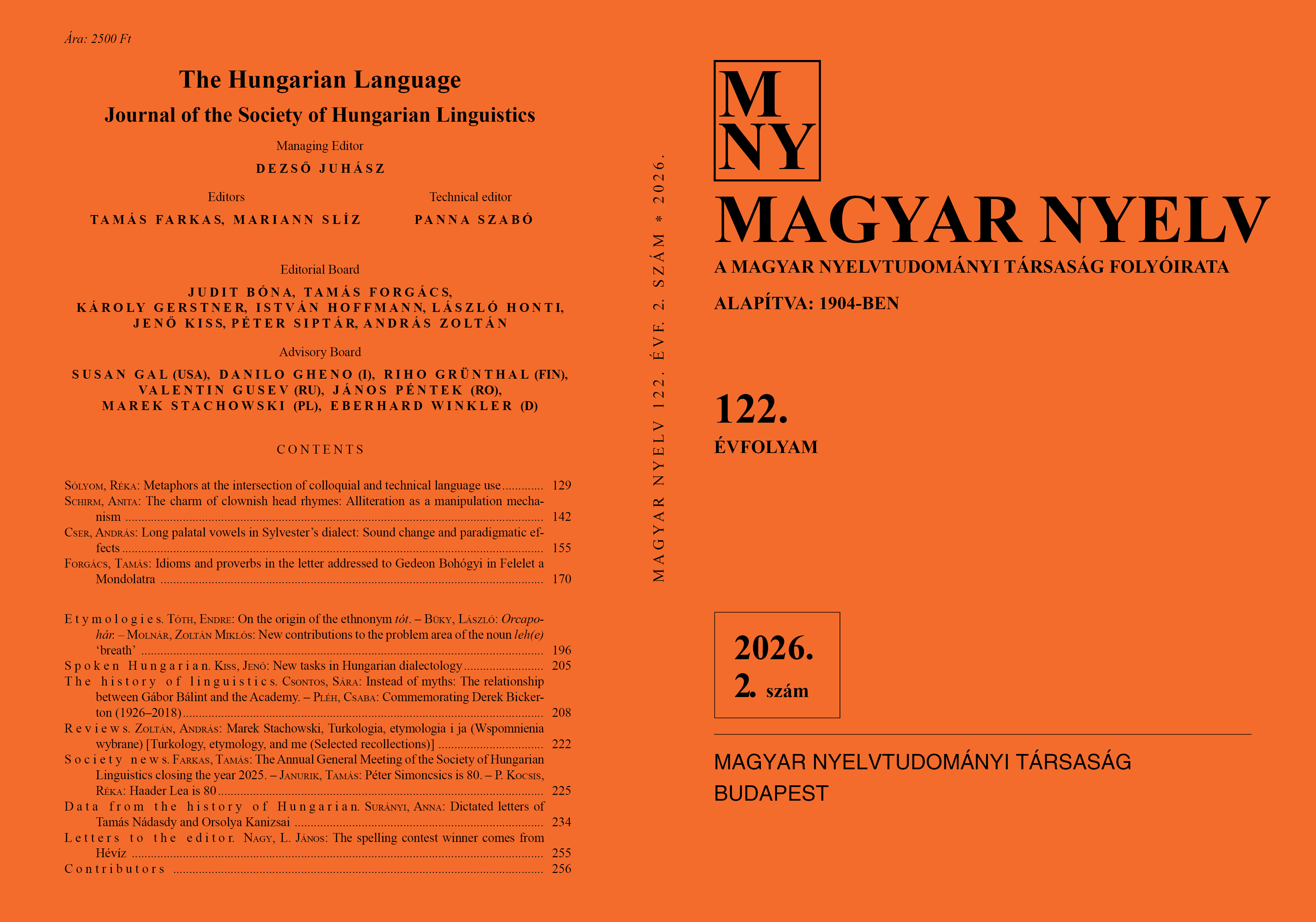
Downloads
Published
Issue
Section
License
Copyright (c) 2026 Réka Sólyom

This work is licensed under a Creative Commons Attribution-NonCommercial-NoDerivatives 4.0 International License.
Magyar Nyelv is a Diamond Open Access periodical. Documents can be freely downloaded and duplicated in an electronic format, and can be used unchanged and with due reference to the original source. Such use must not serve commercial purposes. In the case of any form of dissemination and use, Hungarian Copyright Act LXXVI/1999 and related laws are to be observed. The electronic version of the journal is subject to the regulations of CC BY-NC-ND (Creative Commons – Attribution-NonCommercial-NoDerivatives).
The journal permits its authors, at no cost and without any temporal limitation, to make pre-print copies of their manuscripts publicly available via email or in their own homepage or that of their institution, or in either closed or free-for-all repositories of their institutions/universities, or other non-profit websites, in the form accepted by the journal editor for publication and even containing amendments on the basis of reviewers’ comments. When the authors publicize their papers in this manner, they have to warn their readers that the manuscript at hand is not the final published version of the work. Once the paper has been published in a printed or online form, the authors are allowed (and advised) to use that (post-print) version for the above purposes. In that case, they have to indicate the exact location and other data of the journal publication. The authors retain the copyright of their papers; however, in the case of an occasional secondary publication, the bibliographical data of the first publication have to be included.


