
Válság és politikai nyelvhasználat a Kr. e. 1. századi Rómában
DOI:
https://doi.org/10.63872/ILUG1459Kulcsszavak:
római köztársaság, válságretorika, Cicero, Sallustiius, politikai diskurzusAbsztrakt
A tanulmány a Kr. e. 1. századi római politikai diskurzus retorikai és fogalmi jellemzőit vizsgálja, különös tekintettel arra, hogyan jelenik meg a „válság” fogalma a szenátusi és népgyűlési beszédekben, valamint a korabeli történetírói narratívákban. A szerző a források retorikai szerkezetén keresztül mutatja be, miként konstruálták meg a politikai szereplők a rendkívüli állapot tapasztalatát, és hogyan igazolták döntéseiket válságretorikai eszközökkel. A tanulmány kiemelten foglalkozik Cicero és Sallustius szövegeivel, de kitekintést nyújt más kortárs szerzők nyelvhasználatára is. A válság mint politikai fogalom nemcsak a tényleges történeti eseményeket tükrözi, hanem magát a politikai cselekvést is új keretbe helyezi: a válságra való hivatkozás az önigazolás, a mobilizáció és a legitimáció eszközévé válik.
Hivatkozások
Akar, Ph. 2013. Concordia. Un idéal de la classe dirigeante romaine à la fin de la République. Paris. https://doi.org/10.4000/books.psorbonne.27860
Börm, H. 2019. Mordende Mitbürger. Stasis und Bürgerkrieg in griechischen Poleis des Hellenismus. Stuttgart. https://doi.org/10.25162/9783515123129
Bruce, I. A. F. 1971. "The Corcyrean Civil War of 427 B. C.": Phoenix 25, 108-117. https://doi.org/10.2307/1087521
Burckhardt, L. A. 1990. "The Political Elite of the Roman Republic: Comments on Recent Discussion of the Concepts Nobilitas and Homo Novus": Historia 39, 77-99.
Büchner, K. 1960. Sallust. Heidelberg.
Canfora, L. 2006. "Thucydides in Rome and Late Antiquity": Rengakos, A. - Tsamakis, A. (szerk.): Brill's Companion to Thucydides. Leiden, 721-753. https://doi.org/10.1163/9789047404842_030
Christ, M. R. 1989. "The Authenticity of Thucydides 3.84": Transactions of the American Philological Association 119, 137-148. https://doi.org/10.2307/284265
Edmunds, L. 1975. "Thucydides' Ethics as Reflected in the Description of Stasis (3.82-83)": Harvard Studies in Classical Philology 79, 73-92. https://doi.org/10.2307/311130
Fuks, A. 1971. "Thucydides and the Stasis in Corcyra: Thuc., III, 82-83 versus [Thuc.], III, 84": The American Journal of Philology 92, 48-55. https://doi.org/10.2307/293277
Hanell, K. 1966. "Bemerkungen zu den politischen Terminologie des Sallustius": Klein, R. (szerk.): Das Staatsdenken der Römer. Darmstadt, 500-513.
Hegyi W. Gy. 2017. "A res publica tartalma és képzete": Ókor 16/1, 19-21.
Hölkeskamp, K. - J. 2013. "Concordia contionalis. Die rhetorische Konstruktion von Konsens in der römischen Republik": Flaig, E. - Müller-Luckner, E. (szerk.): Genesis und Dynamiken der Mehrheitsentscheidung. München, 101-128. https://doi.org/10.1515/9783110446760-008
Jackob, N. 2005. Öffentliche Kommunikation bei Cicero. Publizistik und Rhetorik in der späten römischen Republik. Mainz.
Jehne, M. - Lundgreen, Chr. 2013. "Einleitung: Gemeinsinn und Gemeinwohl in der römischen Antike": Uő (szerk.): Gemeinsinn und Gemeinwohl in der römischen Antike. Stuttgart, 9-19. https://doi.org/10.25162/9783515103909
Keil, M. A. 2017. "From Ὁμόνοια to Concordia: The Journey of a Greek Political Ideal to Rome Through Southern Italy": Reid, H. L. - Tanasi, D. - Kimbell, S. (szerk.): Politics and Performance in Western Greece. Sioux City, 331-344. https://doi.org/10.2307/j.ctvbj7grj.24
Kerferd, G. B. 2003. A szofista mozgalom. Ford. Molnár G. Budapest.
Klingner, F. 1928. "Über die Einleitung der Historien Sallusts": Hermes 63, 165-192. https://doi.org/10.1007/BF02625790
Knopf, F. 2013. "Gemeinsinn und Gemeinwohl in der politischen Rhetorik Ciceros und in den Geschichtswerken Sallusts": Jehne, M. - Lundgreen, Chr. (szerk.): Gemeinsinn und Gemeinwohl in der römischen Antike. Stuttgart, 51-72.
Lacey, W. K. 1970. "Boni atque improbi": Greece & Rome 17, 3-16. https://doi.org/10.1017/S0017383500017307
Leppin, H. 1999. Thukydides und die Verfassung der Polis. Ein Beitrag zur politischen Ideengeschichte des 5. Jahrhunderts v. Chr. Berlin. https://doi.org/10.1524/9783050048215
Lundgreen, Ch. 2009. "Geheim(nisvoll)e Abstimmung in Rom. Die leges tabellariae und ihre Konsequenzen für die Comitien und die res publica": Historia 58, 36-70. https://doi.org/10.25162/historia-2009-0002
Macleod, C. W. 1979. "Thucydides on Faction (3.82-83)": Proceedings of the Cambridge Philological Society 25(205), 52-68. https://doi.org/10.1017/S0068673500004119
Meister, K. 2016. "The Fall of the Roman Republic: Sallust's Reading of Thucydides": Thauer, C. R. - Wendt, C. (szerk.): Thucydides and Political Order. Lessons of Governance and the History of the Peloponnesian War. London, 131-150. https://doi.org/10.1057/9781137527752_6
Mutschler, F. - H. 2003. "Geschichtsbetrachtung und Werteorientierung bei Nepos und Sallust": Haltenhoff, A. - Heil, A. - Mutschler, F.-H. (szerk): O tempora, o mores! Römische Werte und römische Literatur in den letzten Jahrzehnten der Republik. München-Leipzig, 259-285. https://doi.org/10.1515/9783110943726.259
Müri, W. 1969. "Politische Metonomasie (zu Thukydides 3, 82, 4-5)": Museum Helveticum 26, 65-79.
Nussbaum, M. C. 1986. The Fragility of Goodness. Luck and Ethics in Greek Tragedy and Philosophy. Cambridge.
Orwin, C. 1988. "Stasis and Plague: Thucydides on the Dissolution of Society": The Journal of Politics 50, 831-847. https://doi.org/10.2307/2131381
Parker, V. 2008. "Between Thucydides and Tacitus. The Position of Sallust in the History of Ancient Historiography": Antike und Abendland 54, 77-104. https://doi.org/10.1515/9783110196733.77
Price, J. 2001. Thucydides and Internal War. Cambridge. https://doi.org/10.1017/CBO9780511483066
Reeve, C. D. C. 1999. "Thucydides on Human Nature": Political Theory 27, 435-446. https://doi.org/10.1177/0090591799027004001
Reinhold, M. 2002. "Human Nature as Causa in Ancient Historiography": Uő: Studies in Classical History and Society. Oxford, 45-53. https://doi.org/10.1093/oso/9780195145434.003.0003
Robb, M. A. 2010. Beyond Populares and Optimates. Political Language in the Late Republic. Historia Einzelschriften 213. Stuttgart.
Rosenblitt, J. A. 2013. "Sallust's Historiae and the Voice of Sallust's Lepidus": Arethusa 46, 447-470. https://doi.org/10.1353/are.2013.0023
Scanlon, T. F. 1978. The Influence of Thucydides on Sallust. PhD dissertation. The Ohio State University.
Schmal, S. 2001. Sallust. Hildesheim-Zürich-New York.
Sheppard, A. R. R. 1984-1986. "Homonoia in the Greek Cities of the Roman Empire": Ancient Society 15/17, 229-252. https://doi.org/10.2143/AS.17.0.2011381
Sklenař, R. 1998. "La République des Signes: Caesar, Cato, and the Language of Sallustian Morality": Transactions of the American Philological Association (1974-2014) 128, 205-220. https://doi.org/10.2307/284413
Solmsen, F. 1971. "Thucydides' Treatment of Words and Concepts": Hermes 99, 385-408.
Spielberg, L. 2017. "Language, Stasis and the Role of the Historian in Thucydides, Sallust and Tacitus": American Journal of Philology 138, 331-373. https://doi.org/10.1353/ajp.2017.0015
Swain, S. 1993. "Thucydides 1.22.1 and 3.82.4": Mnemosyne 46, 33-45. https://doi.org/10.1163/156852593X00033
Szekeres Cs. 2008. "Filozófia és politika Cicerónál": Ókor 7/3, 27-34.
Szekeres Cs. 2009. Az élet vezére. Tanulmányok M. Tullius Cicero filozófiájáról. Debrecen.
Ungern-Sternberg, J. von. 2004. "The Crisis of the Republic": Flower, H. I. (szerk.): The Cambridge Companion to the Roman Republic. Cambridge, 89-109. https://doi.org/10.1017/CCOL0521807948.005
Wassermann, F. M. 1954. "Thucydides and the Disintegration of the Polis": Transactions and Proceedings of the American Philological Association 85, 46-54. https://doi.org/10.2307/283466
White, J. B. 1984. "The Dissolution of Meaning: Thucydides' History of His World": Uő: When Words Lose Their Meaning. Constitutions and Reconstructions of Language, Character, and Community. Chicago-London, 59-92. https://doi.org/10.7208/chicago/9780226056043.001.0001
Wilson, J. 1982. "»The Customary Meanings of Words Were Changed« - Or Were They? A Note on Thucydides 3.82.4": The Classical Quarterly 32, 18-20. https://doi.org/10.1017/S0009838800022758
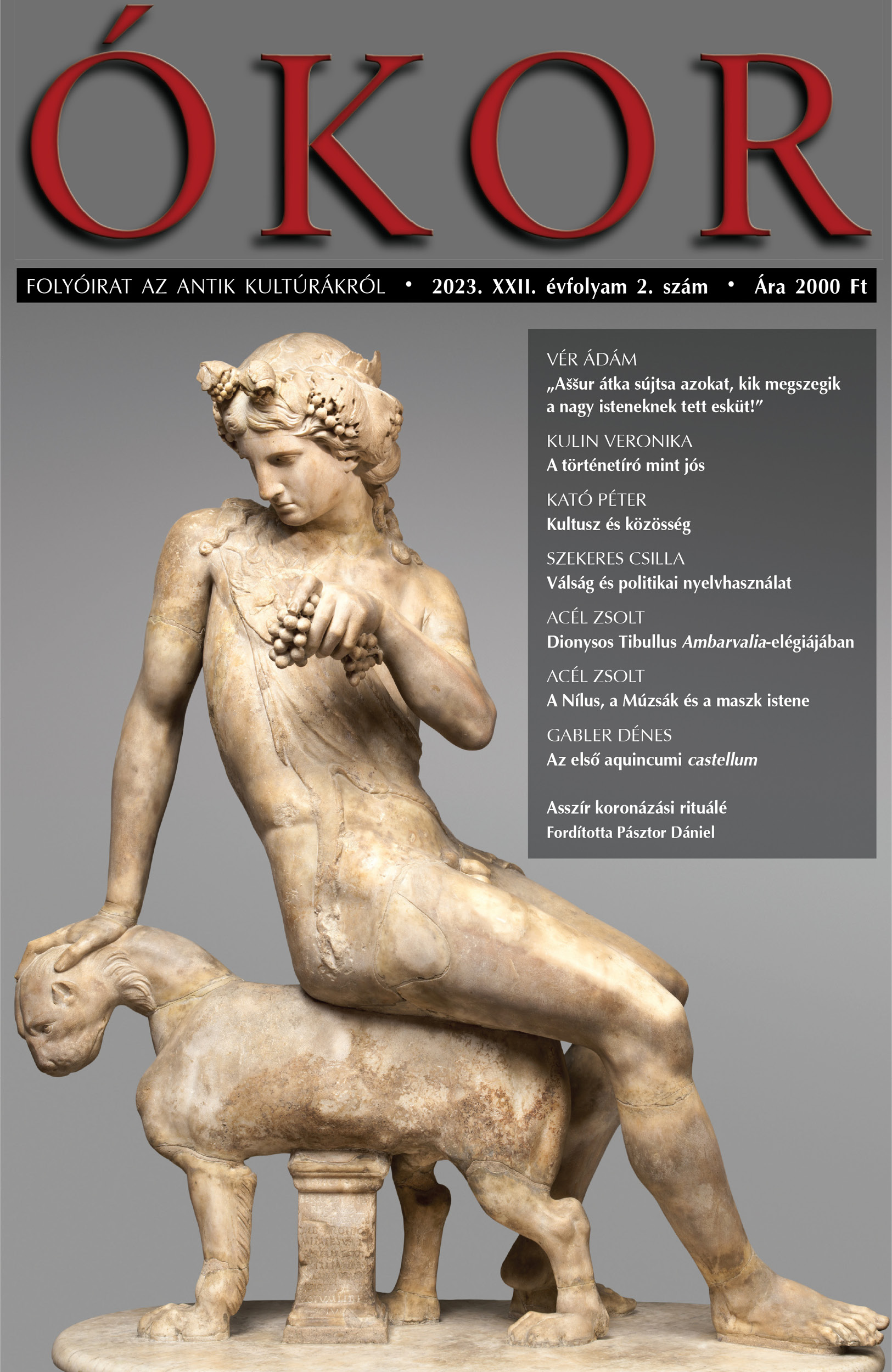
##submission.downloads##
Megjelent
Folyóirat szám
Rovat
License

This work is licensed under a Creative Commons Attribution-NonCommercial 4.0 International License.
