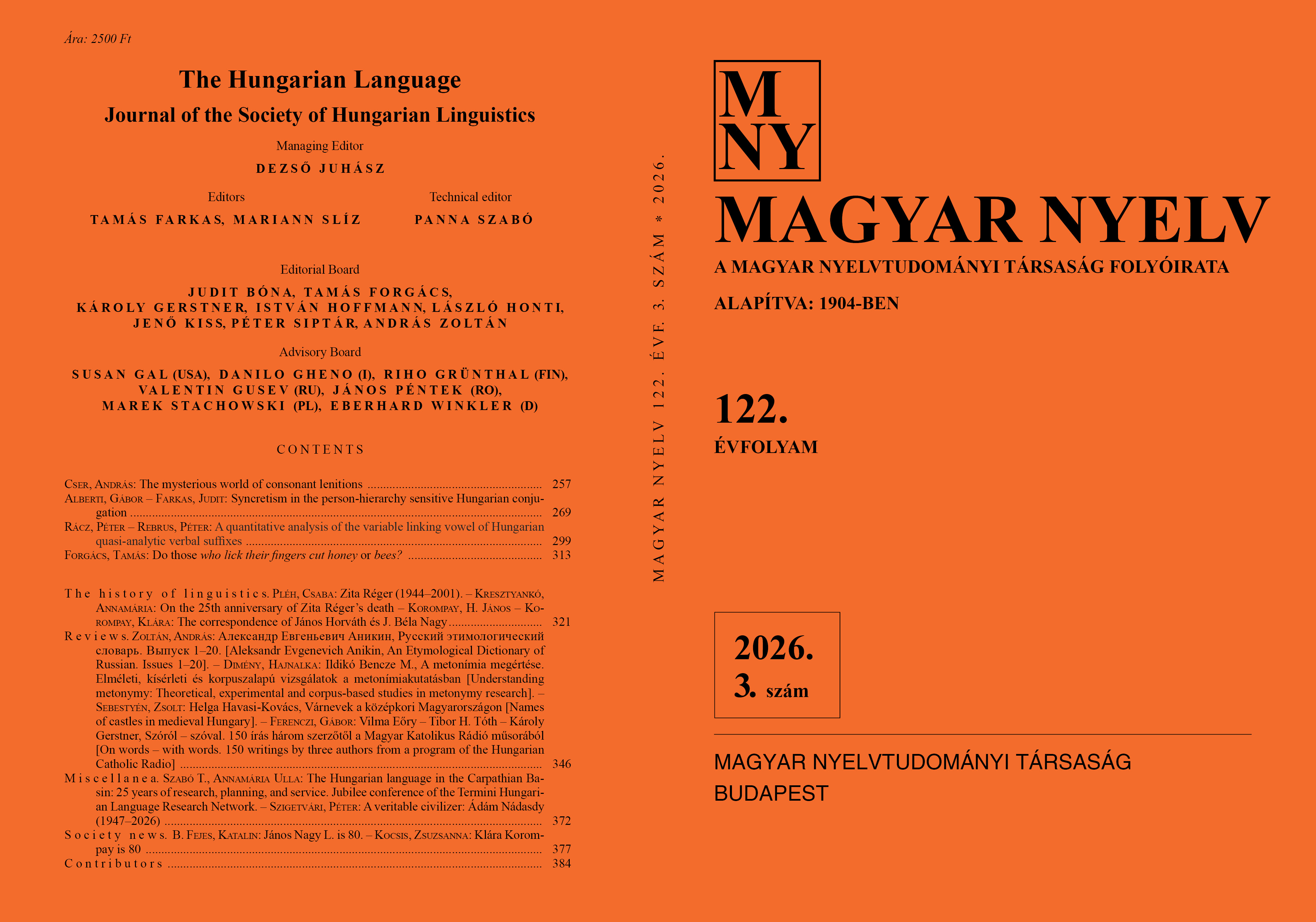
A mássalhangzó-gyengülések rejtélyes világa
DOI:
https://doi.org/10.18349/MagyarNyelv.2026.3.257Kulcsszavak:
mássalhangzó-gyengülés (leníció), hangváltozás, történeti fonológia, mássalhangzó-erősség, reduktív nyelvi változásAbsztrakt
A tanulmány áttekintést nyújt a mássalhangzó-gyengülés (leníció) jelenségéről a történeti nyelvészet és a fonológia nézőpontjából. Kiindulópontja, hogy bár a leníció fogalma széles körben használatos, meghatározása és terjedelme a szakirodalomban máig vitatott. A dolgozat ezért először a gyengülés különböző definícióit és elméleti megalapozásait tekinti át, különös tekintettel a fonetikai és fonológiai megközelítésekre. Ezt követően olyan történeti példákat vizsgál, amelyek rávilágítanak a hangkörnyezet szerepére és arra, hogy a gyengülési folyamatok értelmezése nem vezethető vissza egyszerű környezeti feltételekre. Kitér a szóvégi zöngétlenedés és a hangsúlyfüggő zöngésedés problémájára, valamint ezek tipológiai következményeire. Végül amellett érvel, hogy a mássalhangzó-gyengülések a nyelvi változások általánosan reduktív tendenciájának tágabb összefüggésében érthetők meg. A tanulmány nem a kérdés teljes körű feldolgozására vállalkozik, hanem a legfontosabb fogalmi és elméleti problémák áttekintésére, valamint azok történeti és tipológiai kontextusba helyezésére.
Hivatkozások
E. Abaffy Erzsébet 2003. Hangtörténet. In: Kiss Jenő – Pusztai Ferenc szerk., Magyar nyelvtörténet. Osiris Kiadó, Budapest.
Balogné Bérces, Katalin 2011. Weak and semiweak phonological positions in English. Journal of English Studies 9: 75‒96. https://doi.org/10.18172/jes.160
Balogné Bérces, Katalin 2022. Accent boundaries and linguistic continua in the laryngeal subsystems of English. Linguistics Beyond and Within 8: 24‒36. https://doi.org/10.31743/lingbaw.14955
Balogné Bérces, Katalin ‒ Honeybone, Patrick 2012. Splitting ‘intervocalic’. Expanding the typology of lenition environments. Acta Linguistica Hungarica 59: 27‒48. DOI: 10.1556/aling.59.2012.1-2.2
Bárczi Géza 1958. Magyar hangtörténet. 2., bővített kiadás. Tankönyvkiadó, Budapest.
Bauer, Laurie 2008. Lenition revisited. Journal of Linguistics 44: 605‒624. https://doi.org/10.1017/S0022226708005331
Beekes, Robert 2009. Etymological Dictionary of Greek. Brill, Leiden.
Blevins, Juliette 2004. Evolutionary phonology. The emergence of sound patterns. Cambridge University Press, Cambridge. https://doi.org/10.1017/CBO9780511486357
Blevins, Juliette 2006. A theoretical synopsis of Evolutionary Phonology. Theoretical Linguistics 32: 117–166. https://doi.org/10.1515/TL.2006.009
Brandão de Carvalho, Joaquim ‒ Scheer, Tobias ‒ Ségéral, Philippe eds. 2008. Lenition and Fortition. Mouton de Gruyter, Berlin – New York. https://doi.org/10.1515/9783110211443
Browman, Catherine P. – Goldst ein, Louis M. 1986. Towards an Articulatory Phonology. Phonology Yearbook 3: 219–252. https://doi.org/10.1017/S0952675700000658
Browman, Catherine P. – Goldst ein, Louis M. 1989. Articulatory Gestures as Phonological Units. Phonology 6: 201–251. https://doi.org/10.1017/S0952675700001019
Budenz József 1873. Rövid finn nyelvtan (alaktan) és olvasmányok. Aigner, Budapest.
Budenz József 1880. Finn nyelvtan. 2. kiadás. Knoll, Budapest.
Budenz József 1900. Finn nyelvtan. 5. kiadás. Átdolgozta: Szinnyei József. Hornyánszky, Budapest.
Cser, András 2003. The typology and modelling of obstruent lenition and fortition processes. Akadémiai Kiadó, Budapest.
Cser András 2010. A hangváltozások osztályozásához. Nyelvtudományi Közlemények 106: 115‒131.
Cser, András 2026. Lenition and Fortition. Environments, Processes, and Representations. In: Ledgeway, Adam – Aldridge, Edith – Breitb arth, Anne – É. Kiss , Katalin – Salmons, Joseph – Simonenko, Alexandra eds., The Wiley Blackwell Companion to Diachronic and Historical Linguistics. https://doi.org/10.1002/9781119898023.wbcdl068
Donegan, Patricia – Stampe, David 1979. The Study of Natural Phonology. In: Dinnsen, Daniel ed., Current Approaches to Phonological Theory, Indiana University Press, Bloomington. 126–173.
Dressler, Wolfgang U. – Siptár Péter 1998. A magyar nyelv természetes fonológiája felé. Általános Nyelvészeti Tanulmányok 19: 35–60.
Escure, Geneviève 1977. Hierarchies and phonological weakening. Lingua 43: 55–64. https://doi.org/10.1016/0024-3841(77)90048-1
Fónagy Iván 1963. A metafora a fonetikai műnyelvben. Akadémiai Kiadó, Budapest.
Harris, John 2003. Grammar-internal and grammar-external assimilation. In: Solé, Maria-Josep – Recasens, Daniel – Romero, Joaquin eds., Proceedings of the 15th International Congress of Phonetic Sciences. Causal Productions, Barcelona. 281–284.
Holsinger, David J. 2008. Germanic prosody and consonantal strength. In: Brandão de Carvalho, Joaquim ‒ Scheer, Tobias ‒ Ségéral, Philippe eds., Lenition and Fortition. Mouton de Gruyter, Berlin – New York. 273‒300. https://doi.org/10.1515/9783110211443.2.273
Honeybone, Patrick 2008. Lenition, weakening and consonantal strength: tracing concepts through the history of phonology. In: Brandão de Carvalho, Joaquim ‒ Scheer, Tobias ‒ Ségéral, Philippe eds., Lenition and Fortition. Mouton de Gruyter, Berlin – New York. 9‒92. https://doi.org/10.1515/9783110211443.1.9
Honeybone, Patrick 2012. Lenition in English. In: Nevalainen, Terttu ‒ Traugott, Elizabeth eds., The Oxford Handbook of the History of English. Oxford University Press, New York 773‒787. https://doi.org/10.1093/oxfordhb/9780199922765.013.0064
Hyman, Larry 1975. Phonology. Theory and Analysis. Holt, Reinhart and Winston, New York.
Iverson, Gregory K. – Salmons, Joseph C. 2003a. Laryngeal enhancement in early Germanic. Phonology 20: 43‒74. https://doi.org/10.1017/S0952675703004469
Iverson, Gregory K. ‒ Salmons, Joseph C. 2003b. Legacy Specification in the Laryngeal Phonology of Dutch. Journal of Germanic Linguistics 15: 1‒26.
Iverson, Gregory K. ‒ Salmons, Joseph C. 2007. Domains and directionality in the evolution of German final fortition. Phonology 24: 121‒145. https://doi.org/10.1017/S0952675707001133
Katz, Jonah 2016. Lenition, Perception, and Neutralisation. Phonology 33: 43–85. https://doi.org/10.1017/S0952675716000038
Keller, Rudi 1994. On language change. Routledge, London. https://doi.org/10.4324/9780203993286
Kingst on, John 2008. Lenition. In: Colantoni, Laura ‒ Steele, Jeff rey eds., Selected Proceedings of the 3rd Conference on Laboratory Approaches to Spanish Phonology. Cascadilla Press, Somerville. 1–31.
Kirchner, Robert 1998. An effort-based approach to consonant lenition. Doktori (PhD) értekezés. University of California, Los Angeles.
Kis Tamás 2015. Leíró hangtan és hangtörténet. Magyar Nyelvjárások 52: 89–124.
Lavoie, Lisa 2001. Consonant strength. Phonological patterns and phonetic manifestations. Garland, New York – London.
Lüdtk e, Helmut 1980. Sprachwandel als universals Phänomen. In: Lüdtk e, Helmut Hrsg., Kommunikationstheoretische Grundlagen des Sprachwandels. Walter de Gruyter, Berlin – New York.
Lüdtke, Helmut 1986. Esquisse d’une théorie du changement langagier. La Linguistique 22: 3–46.
D. Mátai Mária 2007. A magyar szófajtörténet általános kérdései. Akadémiai Kiadó, Budapest.
Nyrop, Kristoffer 1899. Grammaire historique de la langue française. Bojesen, Koppenhága.
Nyirkos István 1987. Az inetimologikus mássalhangzók a magyarban. KLTE, Debrecen.
Parker, Steve 2008. Sound Level Protrusions as Physical Correlates of Sonority. Journal of Phonetics 36: 55–90. https://doi.org/10.1016/j.wocn.2007.09.003
Parker, Steve 2011. Sonority. In: van Oostendorp, Marc – Ewen, Colin J. – Hume, Elizabeth – Rice, Keren eds., The Blackwell Companion to Phonology. Wiley-Blackwell, Malden–Oxford. 1160–1184.
Passy, Paul 1890. Etude sur les changements phonetiques. Firmin-Didot, Paris.
Pedersen, Holger 1909. Vergleichende Grammatik der keltischen Sprachen. Vandenhoeck & Ruprecht, Göttingen.
Scheer, Tobias – Ségéral, Philippe 2008. Positional factors in lenition and fortition. In: Brandão de Carvalho, Joaquim ‒ Scheer, Tobias ‒ Ségéral, Philippe eds., Lenition and Fortition. Mouton de Gruyter, Berlin – New York. 131‒172. https://doi.org/10.1515/9783110211443.1.131
Stampe, David 1979. A dissertation on natural phonology. Garland, New York.
Szigetvári Péter 1998. Kormányzás a fonológiában. Általános Nyelvészeti Tanulmányok 19: 165‒214.
Szigetvári, Péter 2008a. What and where? In: Brandão de Carvalho, Joaquim ‒ Scheer, Tobias ‒ Ségéral, Philippe eds., Lenition and Fortition. Mouton de Gruyter, Berlin – New York. 93‒129. https://doi.org/10.1515/9783110211443.1.93
Szigetvári, Péter 2008b. Two directions for lenition. In: Brandão de Carvalho, Joaquim ‒ Scheer, Tobias ‒ Ségéral, Philipp e eds., Lenition and Fortition. Mouton de Gruyter, Berlin – New York. 561‒592. https://doi.org/10.1515/9783110211443.3.561
Thurneysen, Rudolf 1898. Review of Pedersen: Aspirationen i irsk: en sproghistorisk undersögelse. Anzeiger fur indogermanische Sprach- und Altertumskunde. Beiblatt zu den Indogermanischen Forschungen 9: 42–48.
Thurneysen, Rudolf 1909. Handbuch des Alt-Irischen. Winter, Heidelberg.
ÚESz. = Új magyar etimológiai szótár. Szerk. Gerstner Károly. MTA Nyelvtudományi Intézet / ELKH Nyelvtudományi Kutatóközpont, Budapest. https://uesz.nytud.hu (2026. 07. 28.)
##submission.downloads##
Megjelent
Folyóirat szám
Rovat
License
Copyright (c) 2026 András Cser

This work is licensed under a Creative Commons Attribution-NonCommercial-NoDerivatives 4.0 International License.
A periodika Open Access hozzáférésű (Gyémánt). A dokumentumok elektronikus formában szabadon elmenthetők, másolhatók; változtatások nélkül, a forrásra való hivatkozással használhatók. Az alkalmazás kereskedelmi célokat nem szolgálhat. Bármilyen terjesztési és felhasználási forma esetében az 1999. évi LXXVI. szerzői jogról szóló törvény és az ahhoz kapcsolódó jogszabályok az irányadók. Elektronikus változatára a CC BY-NC-ND (Creative Commons – Attribution-NonCommercial-NoDerivatives) licenc feltételei érvényesek.
A folyóirat a szerzők számára időbeli korlátozás nélkül és díjmentesen engedélyezi, hogy kézirataiknak a szerkesztőség által elfogadott, akár a lektori javításokat is tartalmazó, de nem végleges (ún. pre-print) változatait közzétegyék: e-mailen, a szerző vagy intézménye honlapján, illetve a szerző intézményének, egyetemének zárt vagy korlátozás nélkül elérhető repozitóriumában, illetőleg egyéb non-profit szervereken. Amikor a szerző ily módon terjeszti művét, figyelmeztetnie kell olvasóit, hogy a szóban forgó kézirat nem a mű végső, kiadott változata. Ha a cikk végső változata már megjelent nyomtatott, illetve online formában, mindenképpen javasolt és engedélyezett a szerzőnek ezen (post-print) változatot használnia. Ebben az esetben meg kell adnia a folyóiratbeli megjelenés pontos helyét, adatait is. A szerző a közlemény szerzői jogait megtartja, esetleges másodközlés esetén azonban a cikk első megjelenésének bibliográfiai adatait is közölnie kell.